Summary
Biophysical models trained on single and double point mutations can predict effects of three or more mutations on stability (1). Authors trained biophysical models on single and double missense mutations, which then generalized to a median of 13 mutations with high correlation. They conclude that “when global nonlinearities due to cooperative protein folding are properly accounted for and measurements are averaged across genetic backgrounds, first-order and pairwise energetic couplings provide sufficient information for many prediction tasks”. In contrast, (2), who trained an EGNN on the data from (3), found that models trained on single/double point mutations don’t generalize to more mutations.
Figures
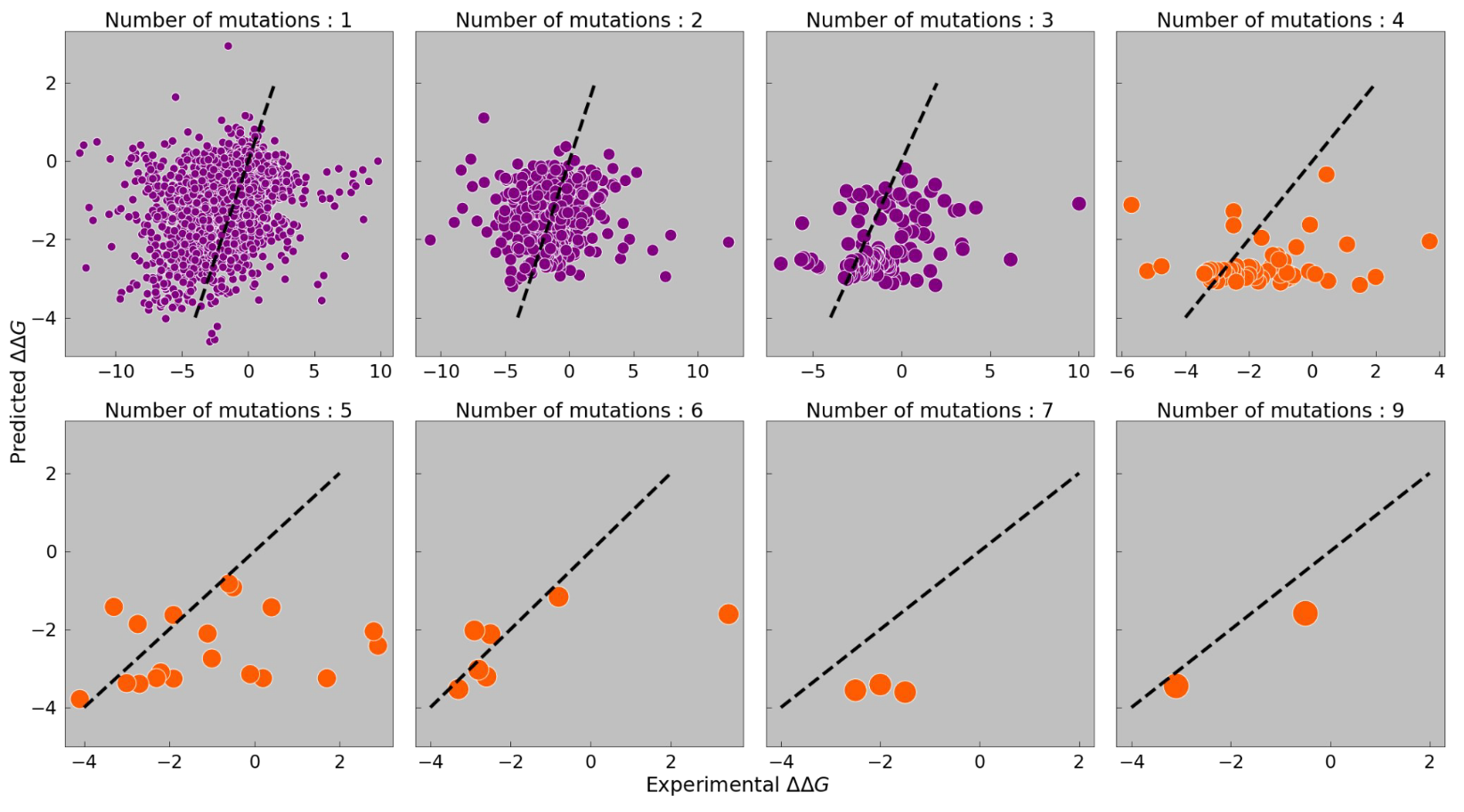 Purple: p < 0.05, orange: p > 0.05.
Ref (2)
Purple: p < 0.05, orange: p > 0.05.
Ref (2)
See also
1.
Faure AJ, Martí-Aranda A, Hidalgo-Carcedo C, Beltran A, Schmiedel JM, Lehner B. The genetic architecture of protein stability. Nature. 2024;634(8035):995–1003. Available from: https://doi.org/10.1038/s41586-024-07966-0
2.
Boyer S, Money-Kyrle S, Bent O. Predicting protein stability changes under multiple amino acid substitutions using equivariant graph neural networks. 2023; Available from: https://arxiv.org/abs/2305.19801
3.
Tsuboyama K, Dauparas J, Chen J, Laine E, Mohseni Behbahani Y, Weinstein JJ, et al. Mega-scale experimental analysis of protein folding stability in biology and design. Nature. 2023;620(7973):434–44. Available from: https://doi.org/10.1038/s41586-023-06328-6