Markov state models (MSMs) are a framework for assigning frames of an MD simulation to a small number of specific states.
Details
(1) describe the process of building an MSM as follows: (1) featurize data (e.g., dihedral angles, contact maps) such that roto-translational invariance is maintained; (2) preprocess the data by transforming using methods such as time-lagged independent component analysis with a chosen lag time; (3) cluster the data to obtain discrete, disjoint states; (4) estimate a transition matrix using the prespecified lag time; (5) assess correctness using the Chapman-Kolmogorov test.
Figures
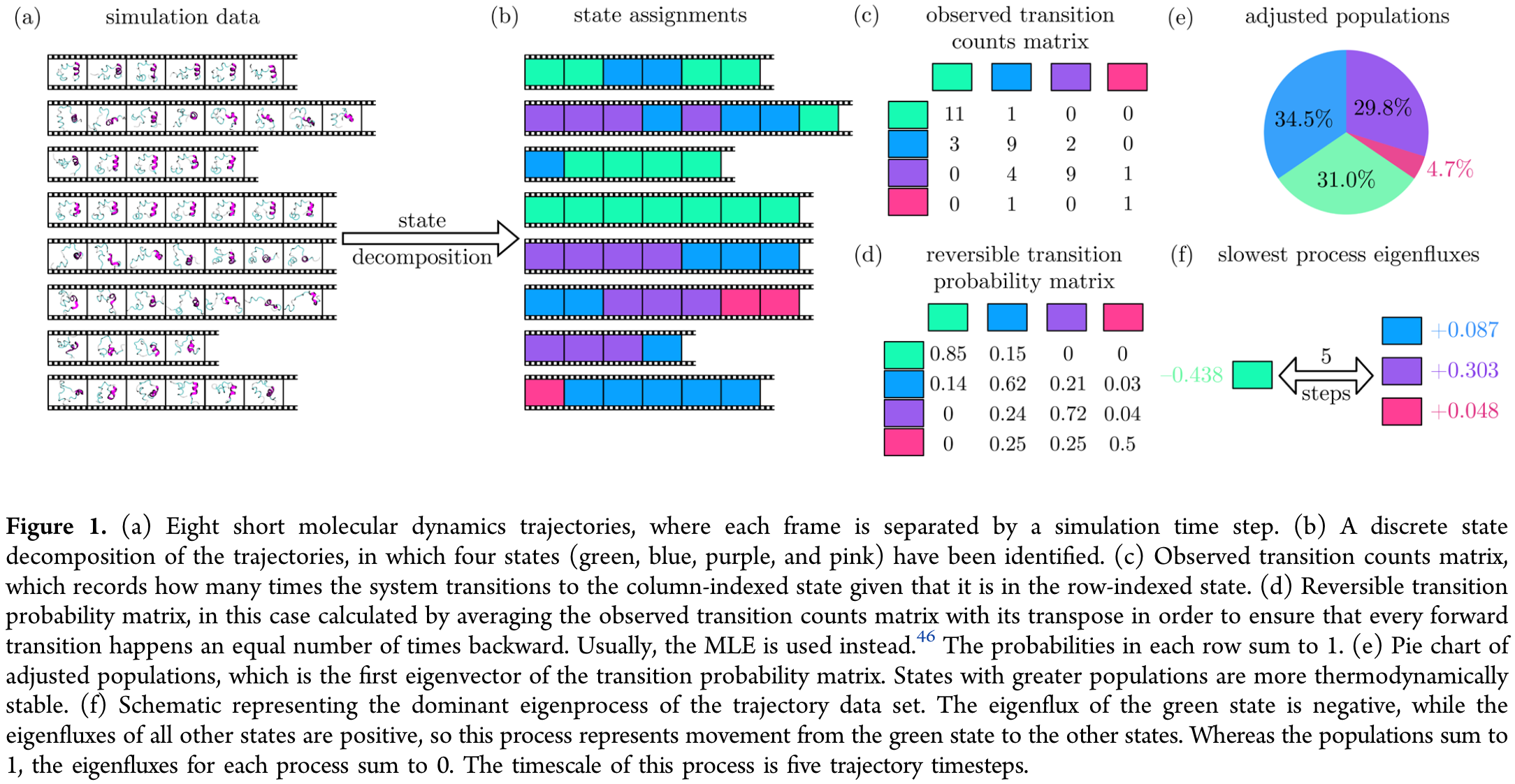 Ref (2)
1.
Glielmo A, Husic BE, Rodriguez A, Clementi C, Noé F, Laio A. Unsupervised Learning Methods for Molecular Simulation Data. Chemical Reviews. 2021;121(16):9722–58. Available from: https://doi.org/10.1021/acs.chemrev.0c01195
2.
Husic BE, Pande VS. Markov State Models: From an Art to a Science. Journal of the American Chemical Society. 2018;140(7):2386–96. Available from: https://doi.org/10.1021/jacs.7b12191