Summary
All-atom structure-and-affinity predictors partially generalize from wild-type protein-drug binding to the effects of point mutations, but mutant predictions are less accurate (1). Across hERG, NaV1.5, HER2, and CYP3A4, Boltz-2 affinity predictions reached Pearson correlations with experimental IC50 values of up to 0.76 for wild-type proteins and 0.60 for mutants.
The evaluation compared the default setting of 200 diffusion steps and five samples with increased-sampling settings of 300 steps and seven samples or 400 steps and nine samples.
Figures
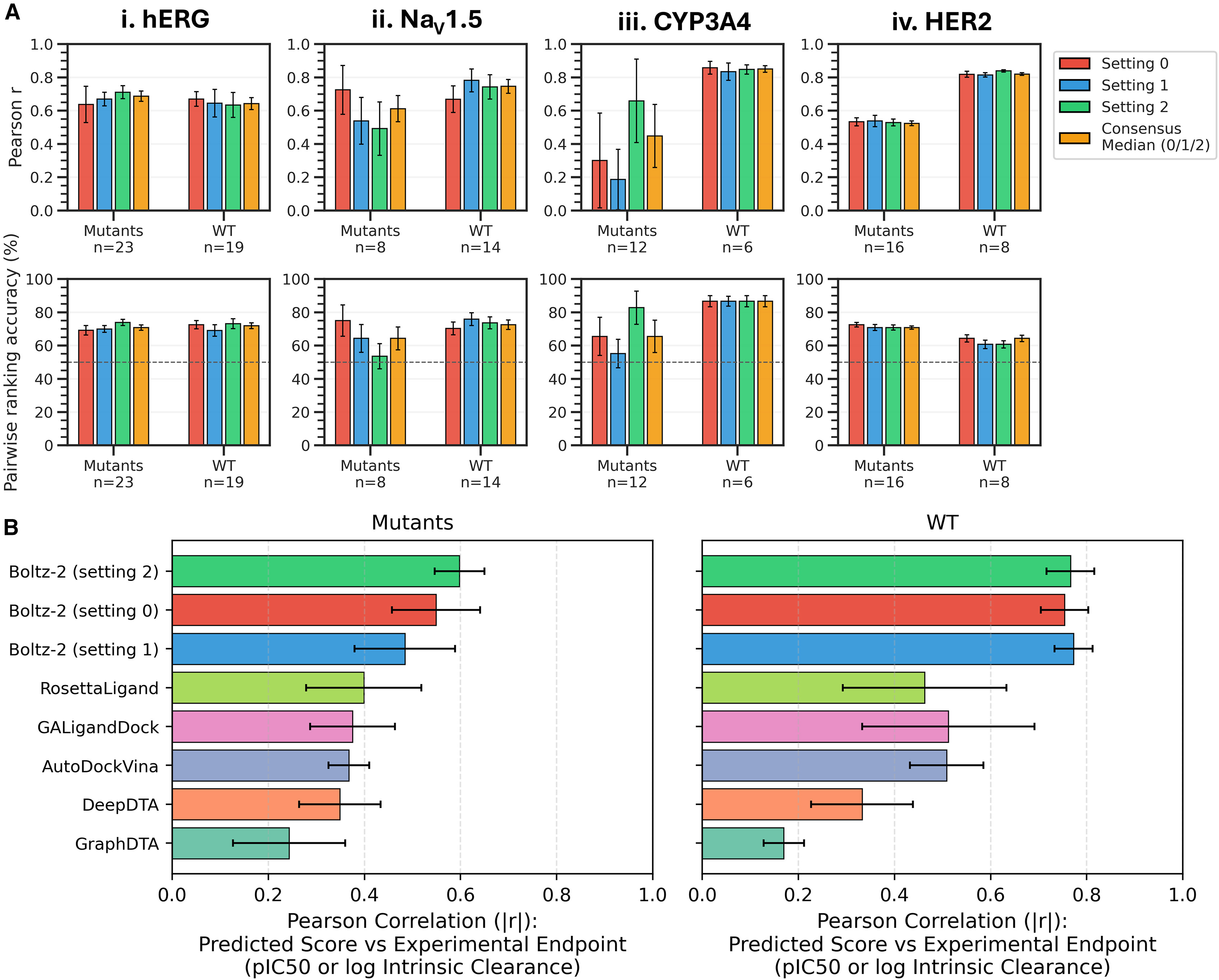
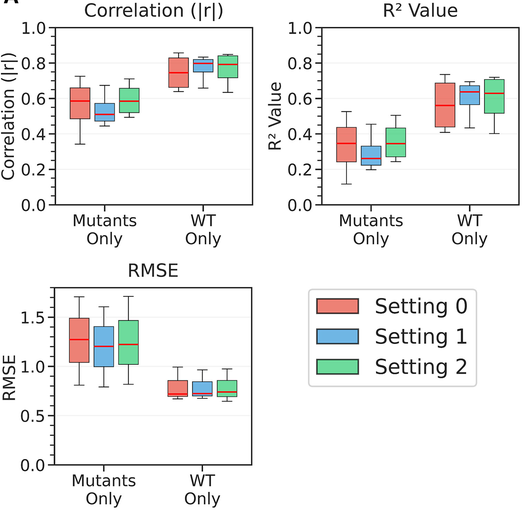 Settings 0, 1, and 2 have 200, 300, and 400 diffusion steps and 5, 7, and 9 samples . Ref (1)
See also
- AF3 binding affinity predictions are orthogonal to those made by force fields and other neural networks
- The Boltz-2 affinity module cannot be effectively repurposed for PPI affinity prediction
- Structure-based methods outperform sequence-based methods at zero-shot prediction of binding, whereas the reverse is true for zero-shot prediction of enzymatic activity
- Increasing diffusion samples is sufficient to yield correctly predicted antibody-antigen complexes
- Large-scale measurements, such as Kd and IC50, from different assays correlate weakly in different studies
1.
Ngo K, Carraway KL, Clancy CE, Amini H. BoltzOmics: Predicting genetic variant effects on drug binding with Boltz-2. iScience. 2026; Available from: https://doi.org/10.1016/j.isci.2026.116797