Summary
Structure-based methods, such as inverse folding models, outperform sequence-based methods such as protein language models and Potts models at zero-shot binding prediction, whereas the reverse is true for zero-shot prediction of enzymatic activity (1).
Figures
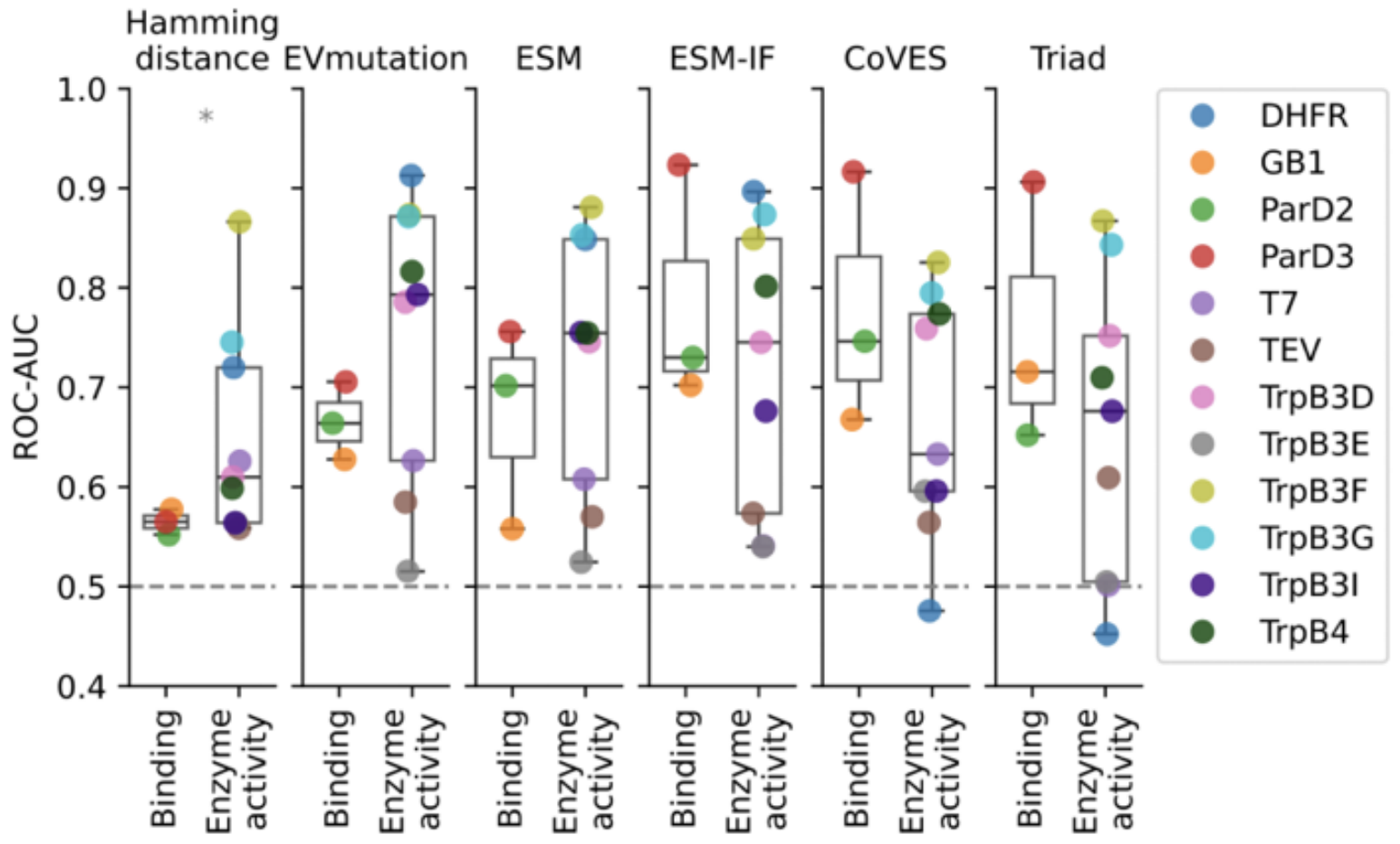
Ref (1)
See also
- Structure-based methods outperform sequence-based methods on protein stability prediction of point mutants, but not full sequences
- Structure-based methods outperform sequence-based methods on antigen-dependent antibody design
1.
Li F-Z, Yang J, Johnston KE, Gürsoy E, Yue Y, Arnold FH. Evaluation of machine learning-assisted directed evolution across diverse combinatorial landscapes. Cell Systems. 2025;16(9):101387. Available from: https://doi.org/10.1016/j.cels.2025.101387