Summary
Natural selection favors the highest average local fitness, rather than the absolute highest fitness (1,2). An example of this is dihydrofolate reductase (3).
Details
Authors mention that quasi-species theory states that “survival of the flattest” rewards occupancy of flatter minima rather than high mutation or replication rates:
“Faster replicating organisms can easily be out-competed at high mutation rates by organisms that replicate more slowly, if the latter obtain sufficient support from their mutational neighbourhood. Even a 12-fold difference in replication rate could be overcome by greater mutational robustness of the slower replicator.”
Experimental evidence supporting this model was obtained in viral samples by (2).
Figures
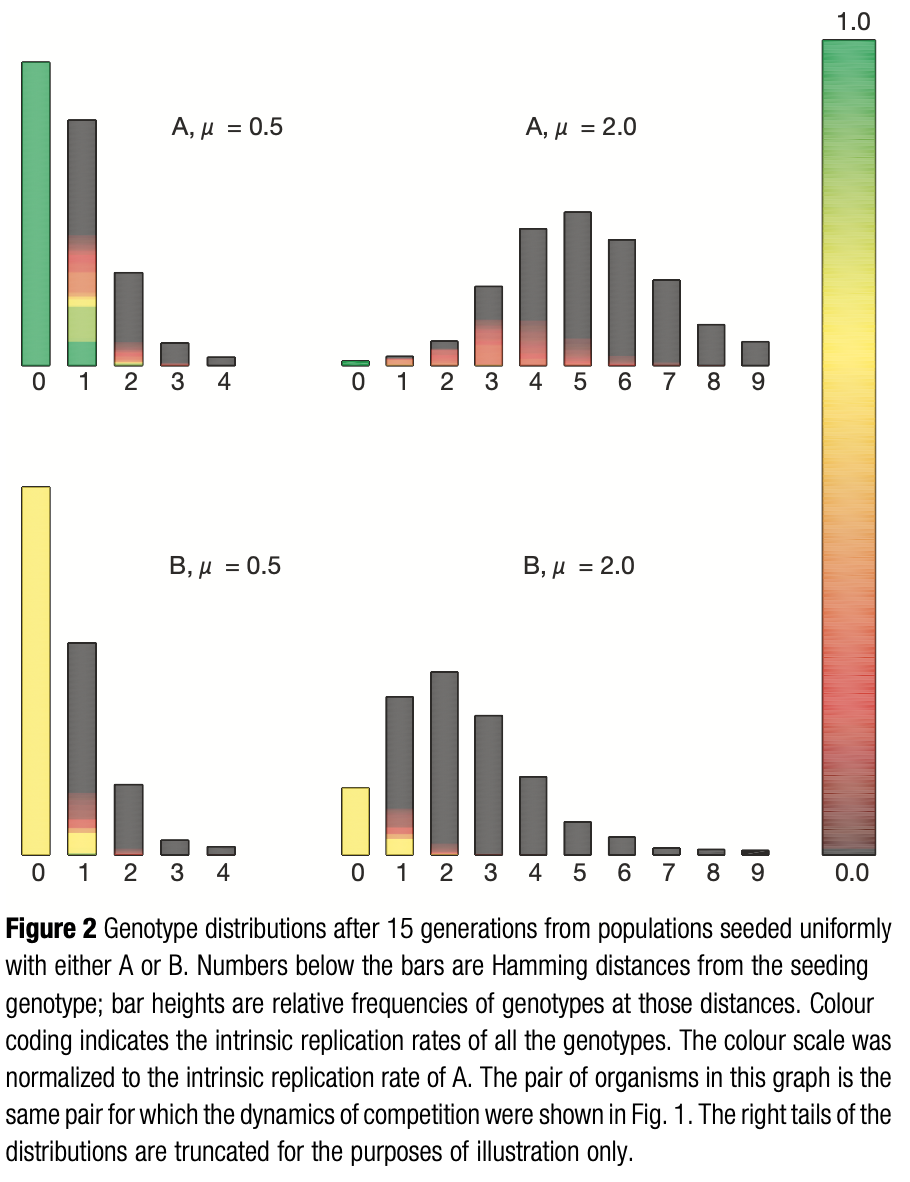 Ref (1)
See also
- Natural sequences deviate from highest stability variants
- Natural selection favors the highest average local fitness
1.
Wilke CO, Wang JL, Ofria C, Lenski RE, Adami C. Evolution of digital organisms at high mutation rates leads to survival of the flattest. Nature. 2001;412(6844):331–3. Available from: https://doi.org/10.1038/35085569
2.
Codoñer FM, Darós J-A, Solé RV, Elena SF. The Fittest versus the Flattest: Experimental Confirmation of the Quasispecies Effect with Subviral Pathogens. PLoS Pathogens. 2006;2(12):e136. Available from: https://doi.org/10.1371/journal.ppat.0020136
3.
Papkou A, Garcia-Pastor L, Escudero JA, Wagner A. A rugged yet easily navigable fitness landscape. Science. 2023;382(6673). Available from: https://doi.org/10.1126/science.adh3860