Summary
The pLDDT and PAE of AlphaFold2 predictions is inversely correlated with RMSD between conformations observed experimentally ((1) and Chakravarty and (2)) and from MD simulations (3,4). Low pLDDT is also predictive of intrinsic disorder. However, in de novo proteins, pLDDT predictions do not correlate with flexibility, based on studies with NMR (5). This is a form of aleotoric uncertainty in the neural network’s confidence prediction module.
Figures
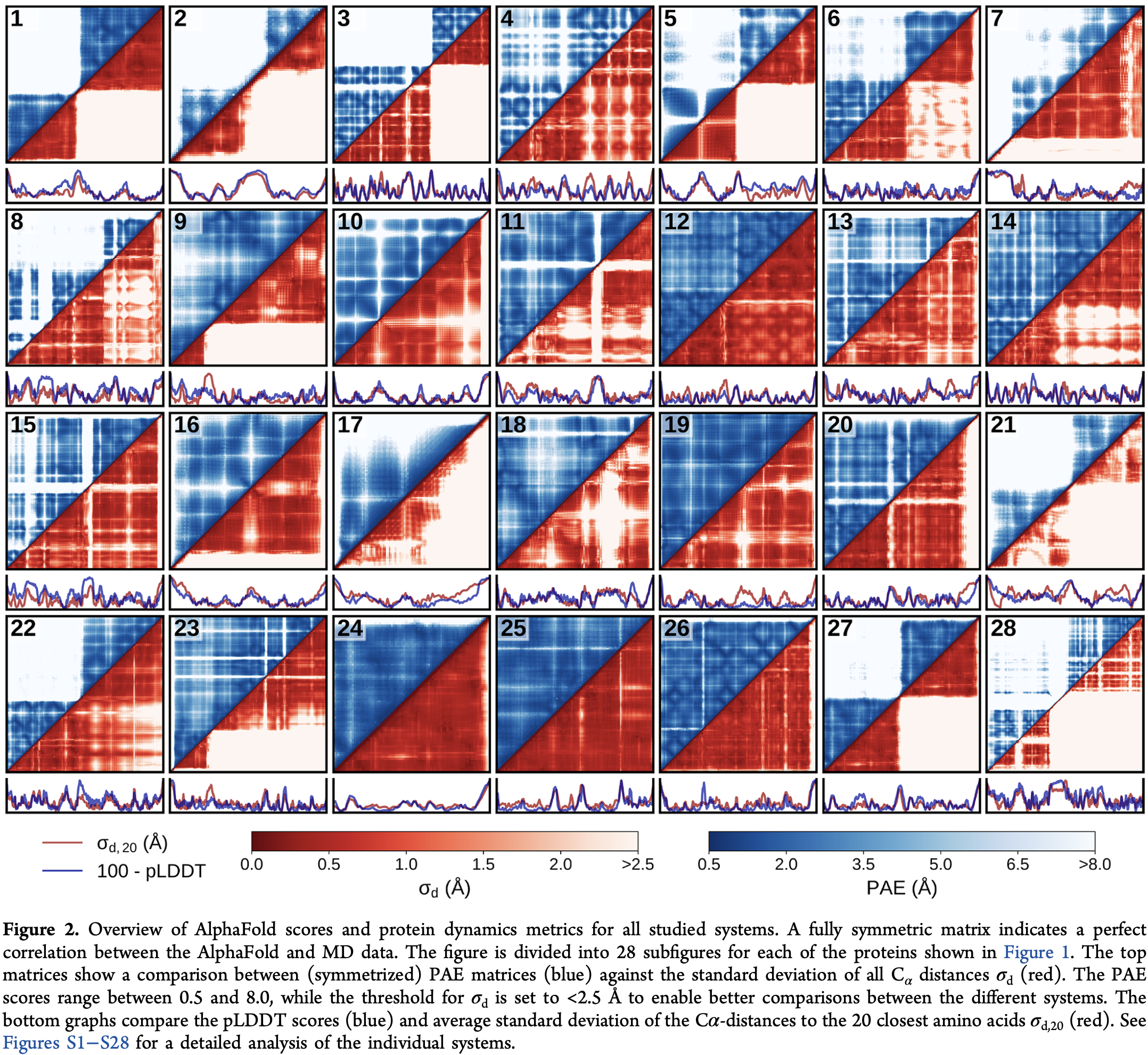
Ref (3)
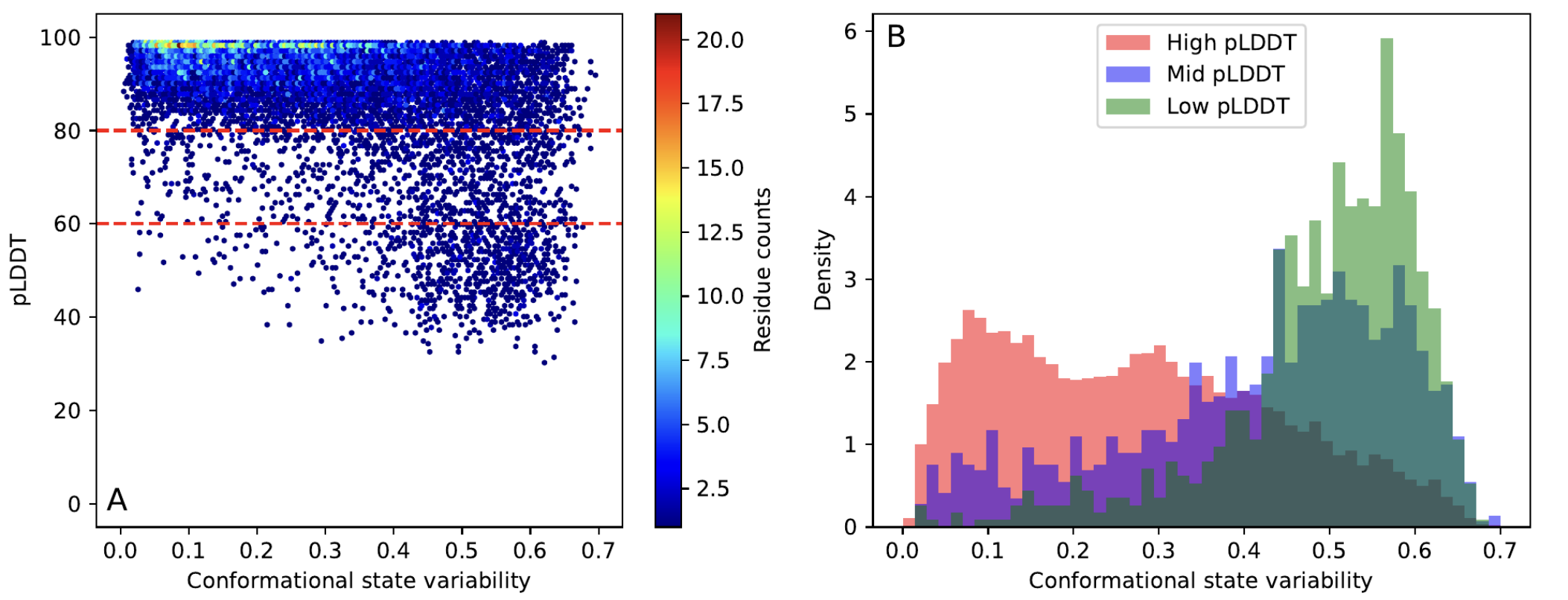
Ref (4)
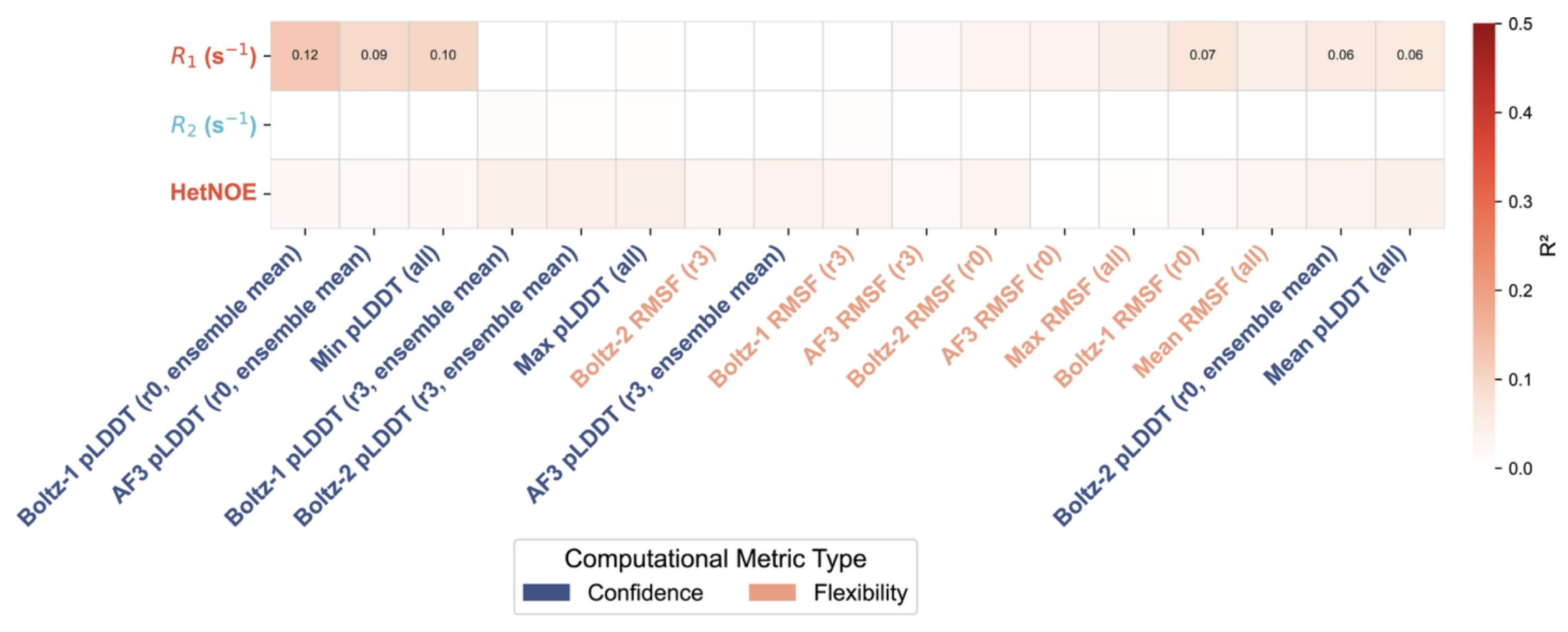
Ref (5)
1.
Saldaño T, Escobedo N, Marchetti J, Zea DJ, Mac Donagh J, Velez Rueda AJ, et al. Impact of protein conformational diversity on AlphaFold predictions. Bioinformatics. 2022;38(10):2742–8. Available from: https://doi.org/10.1093/bioinformatics/btac202
2.
Chakravarty D, Porter LL. AlphaFold2 fails to predict protein fold switching. Protein Science. 2022;31(6). Available from: https://doi.org/10.1002/pro.4353
3.
Jussupow A, Kaila VRI. Effective Molecular Dynamics from Neural Network-Based Structure Prediction Models. Journal of Chemical Theory and Computation. 2023;19(7):1965–75. Available from: https://doi.org/10.1021/acs.jctc.2c01027
4.
Gavalda-Garcia J, Dixit B, Díaz A, Ghysels A, Vranken W. Gradations in protein dynamics captured by experimental NMR are not well represented by AlphaFold2 models and other computational metrics. Journal of Molecular Biology. 2025;437(2):168900. Available from: https://doi.org/10.1016/j.jmb.2024.168900
5.
Müntener T, Abramson D, Stern E, Hertel I, Jankevicius G, Mas G, et al. Large-scale exploration of protein space by automated NMR. openRxiv; 2026. Available from: https://doi.org/10.64898/2026.02.16.706194