Summary
AlphaFold3 ipTM can distinguish antibodies that bind and those that don’t with an AUC of 0.86 (1). This was corroborated in one subsequent prospective study(2), whereas another study found this to be target-dependent(3) (see figure below for details). However, previous studies have not found the same for AlphaFold2-generation models (4). Meanwhile fine-tuned RosettaFold was also unable to distinguish these, suggesting a very high base level of performance is required to distinguish binders and nonbinders. A larger retrospective benchmark reached a maximum recall of 53% at 100 seeds with a roughly 3% false-positive rate; performance decreased with antigen size and disorder, but no significant bias was detected from antibody CDR composition or length (5). ipTM also depends on how the input chains are trimmed, independently of the predicted binding mode (6).
Figures
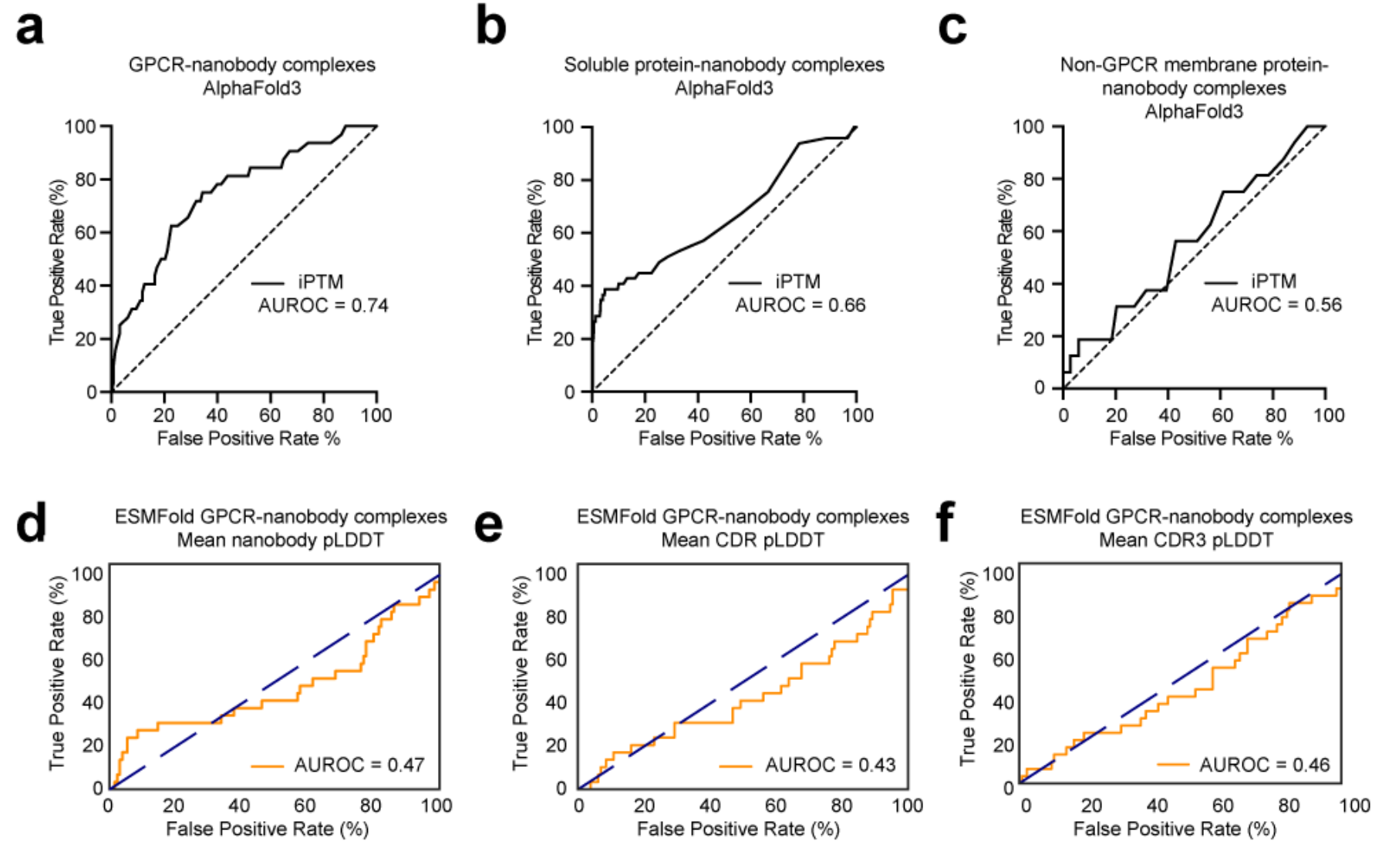 Ref(3)
See also
- PAE weakly correlates with Ab-Ag binding
- Protein structure prediction and design confidence metrics do not correlate with binding affinity
- Boltz-2 intermediate representations can predict protein-protein binding affinity
- Ensembling structure prediction methods for filtering improves recovery