Summary

Sequences designed by Ancestral sequence reconstruction have greater thermostability and enzymatic activity than extant sequences (1). However, there is some controversy about whether this says anything about how such sequences actually evolved.

Details

Williams et al. found using simulations that the probability-maximizing methods used to reconstruct these sequences are biased in favor of increasing both thermostability, even when that was not explicitly the case. (2) Additionally, in one study by (3), a reconstructed mammalian sequence was so unusually stable at high temperatures, the authors found to be suspicious that mammals regulate their internal body temperature.

Sennett et al. provide evidence against the idea that the process of ancestral reconstruction leads to proteins with artificially increased thermostability. (4)

Figures
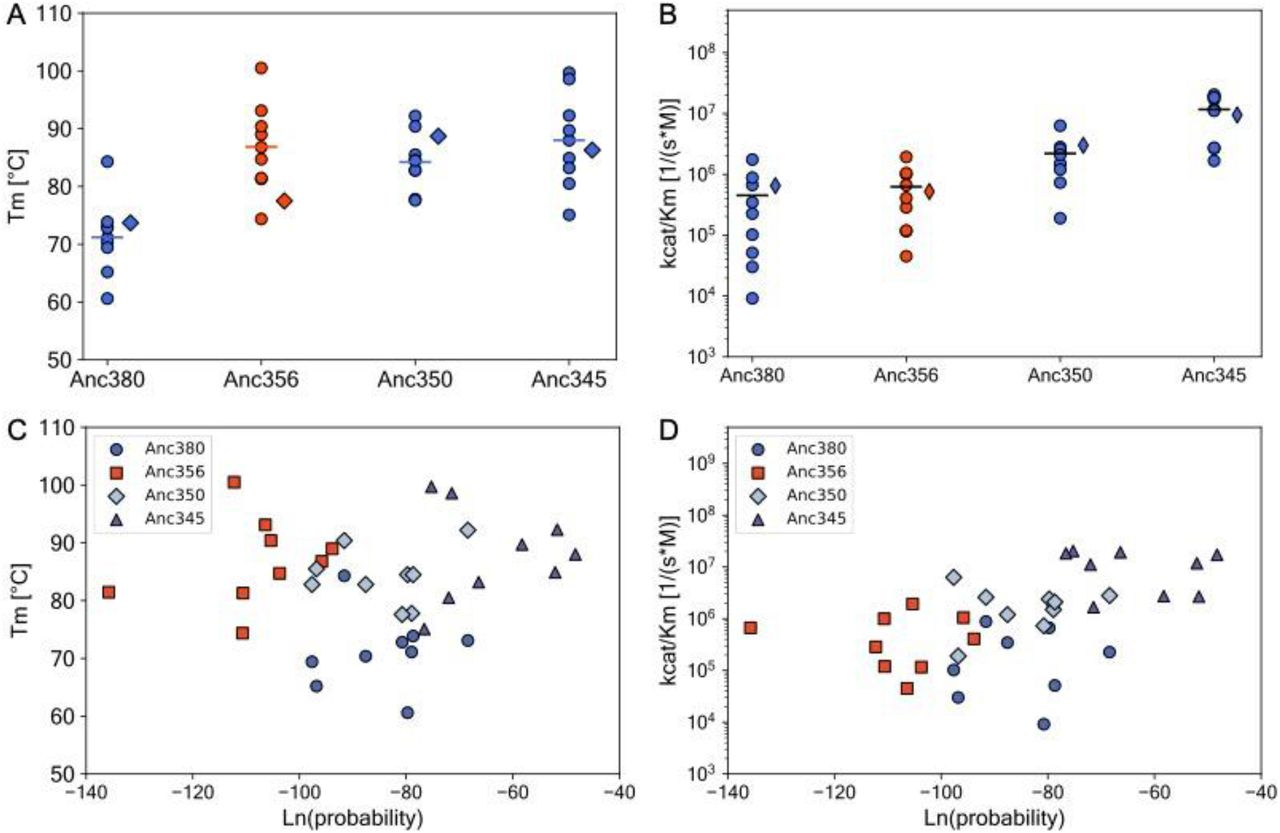
From (4)

1.
Wilding M, Peat TS, Kalyaanamoorthy S, Newman J, Scott C, Jermiin LS. Reverse engineering: transaminase biocatalyst development using ancestral sequence reconstruction. Green Chemistry. 2017;19(22):5375–80. Available from: https://doi.org/10.1039/c7gc02343j
2.
Williams PD, Pollock DD, Blackburne BP, Goldstein RA. Assessing the Accuracy of Ancestral Protein Reconstruction Methods. PLoS Computational Biology. 2006;2(6):e69. Available from: https://doi.org/10.1371/journal.pcbi.0020069
3.
Trudeau DL, Kaltenbach M, Tawfik DS. On the Potential Origins of the High Stability of Reconstructed Ancestral Proteins. Molecular Biology and Evolution. 2016;33(10):2633–41. Available from: https://doi.org/10.1093/molbev/msw138
4.
Sennett MA, Beckett BC, Theobald DL. The most probable ancestral sequence reconstruction yields proteins without systematic bias in thermal stability or activity. openRxiv; 2023. Available from: https://doi.org/10.1101/2023.02.22.529562