Summary
During affinity maturation, clonal expansion correlates with antigen binding, and larger clonal families are more likely to bind with higher affinity than smaller ones (1). Put another way, overrepresented antibodies are more likely to be strong binders than weak binders. This fact was used to train AntiBERTy (2).
Details
This is a repertoire-level enrichment, not a quantitative affinity measurement: raw sequence abundance after selection can correlate poorly with affinity (3,4). Quantitative NGS-based affinity estimates instead require titration and sorting across measurement bins (5).
Figures
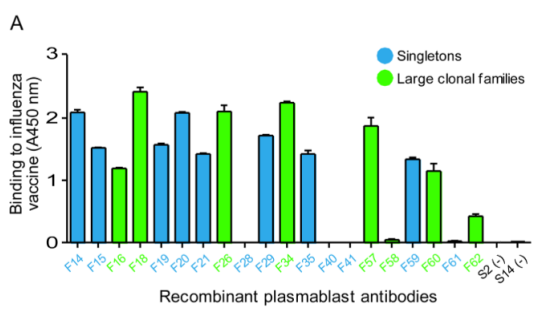 Ref (6)
See also
- PLMs cluster antibodies from the same repertoire by V gene and maturation status
- NGS sequence abundance does not correlate with binding affinity
1.
Robinson WH. Sequencing the functional antibody repertoire—diagnostic and therapeutic discovery. Nature Reviews Rheumatology. 2014;11(3):171–82. Available from: https://doi.org/10.1038/nrrheum.2014.220
2.
Ruffolo JA, Gray JJ, Sulam J. Deciphering antibody affinity maturation with language models and weakly supervised learning. 2021; Available from: https://arxiv.org/abs/2112.07782
3.
Paul S, Harvey EP, Osei-Owusu J, Kollasch AW, Riesselman AJ, McMahon C, et al. Machine learning enables efficient and effective affinity maturation of nanobodies. openRxiv; 2026. Available from: https://doi.org/10.64898/2026.01.11.698911
4.
Makowski EK, Kinnunen PC, Huang J, Wu L, Smith MD, Wang T, et al. Co-optimization of therapeutic antibody affinity and specificity using machine learning models that generalize to novel mutational space. Nature Communications. 2022;13(1). Available from: https://doi.org/10.1038/s41467-022-31457-3
5.
Adams RM, Mora T, Walczak AM, Kinney JB. Measuring the sequence-affinity landscape of antibodies with massively parallel titration curves. eLife. 2016;5:e23156. Available from: https://doi.org/10.7554/elife.23156
6.
Tan Y-C, Blum LK, Kongpachith S, Ju C-H, Cai X, Lindstrom TM, et al. High-throughput sequencing of natively paired antibody chains provides evidence for original antigenic sin shaping the antibody response to influenza vaccination. Clinical Immunology. 2014;151(1):55–65. Available from: https://doi.org/10.1016/j.clim.2013.12.008