Summary
Antibody language models learn about both V gene usage and affinity maturation status (how far antibody sequences are from germline). This has been observed in AntiBERTy, AbLang, and PALM (1–2). Progression of sequences in immune repertoires can be observed in dimensionality reduction of AntiBERTy embeddings (t-SNE). This was also shown with AntiBERTa but not SAPIENS or ProtBERT.
Figures
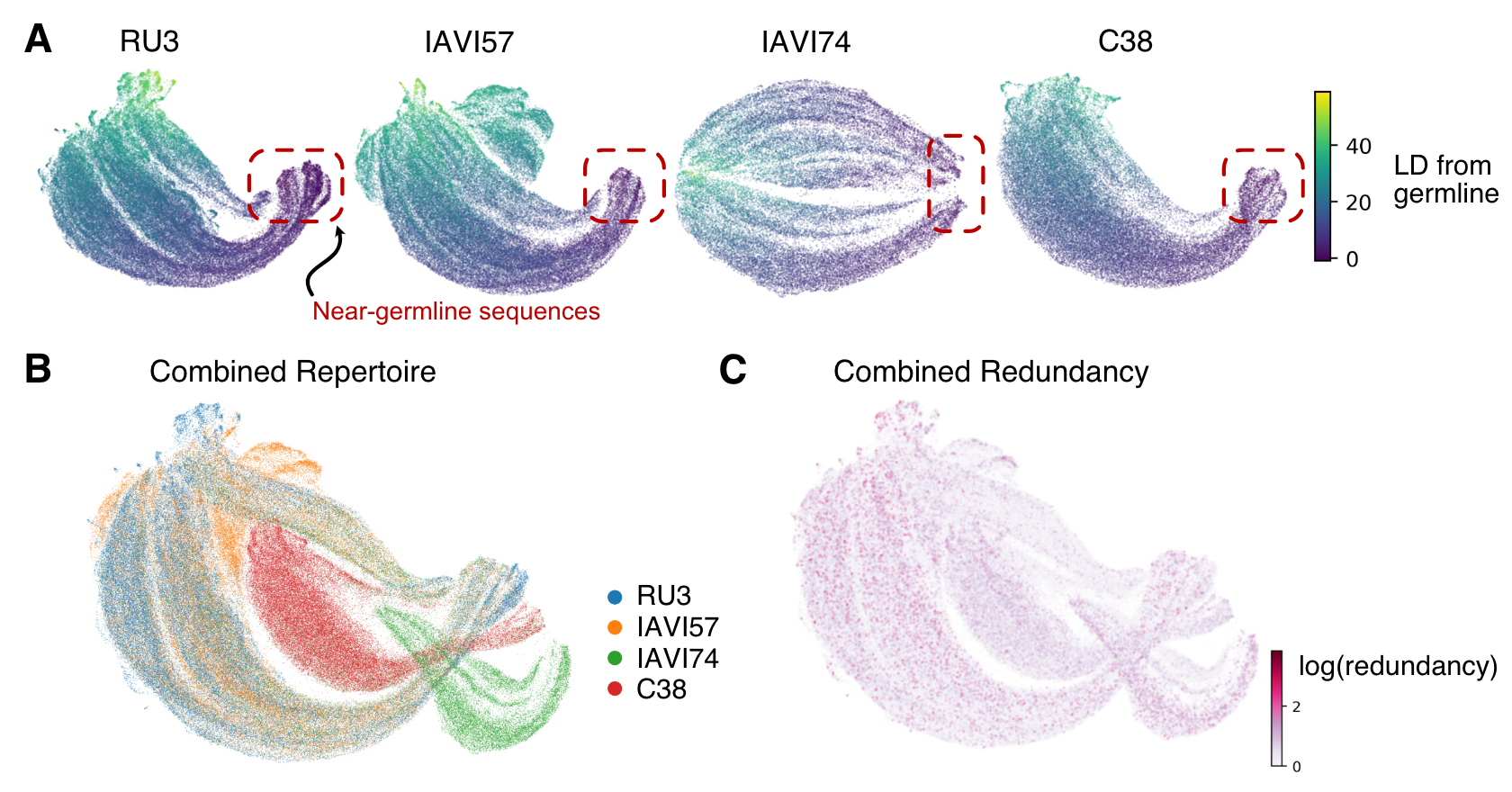 Ref (1)
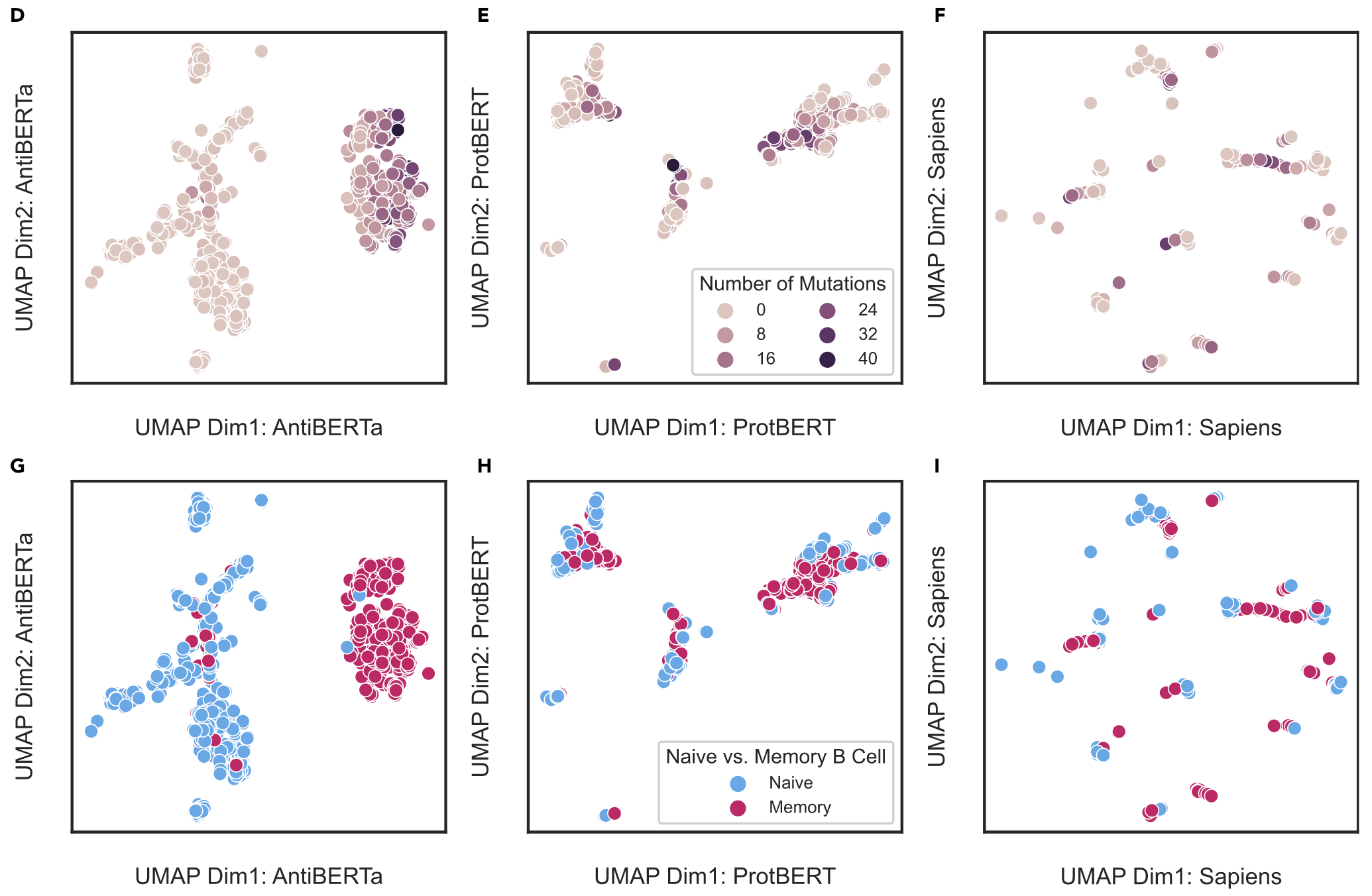 Ref (4)
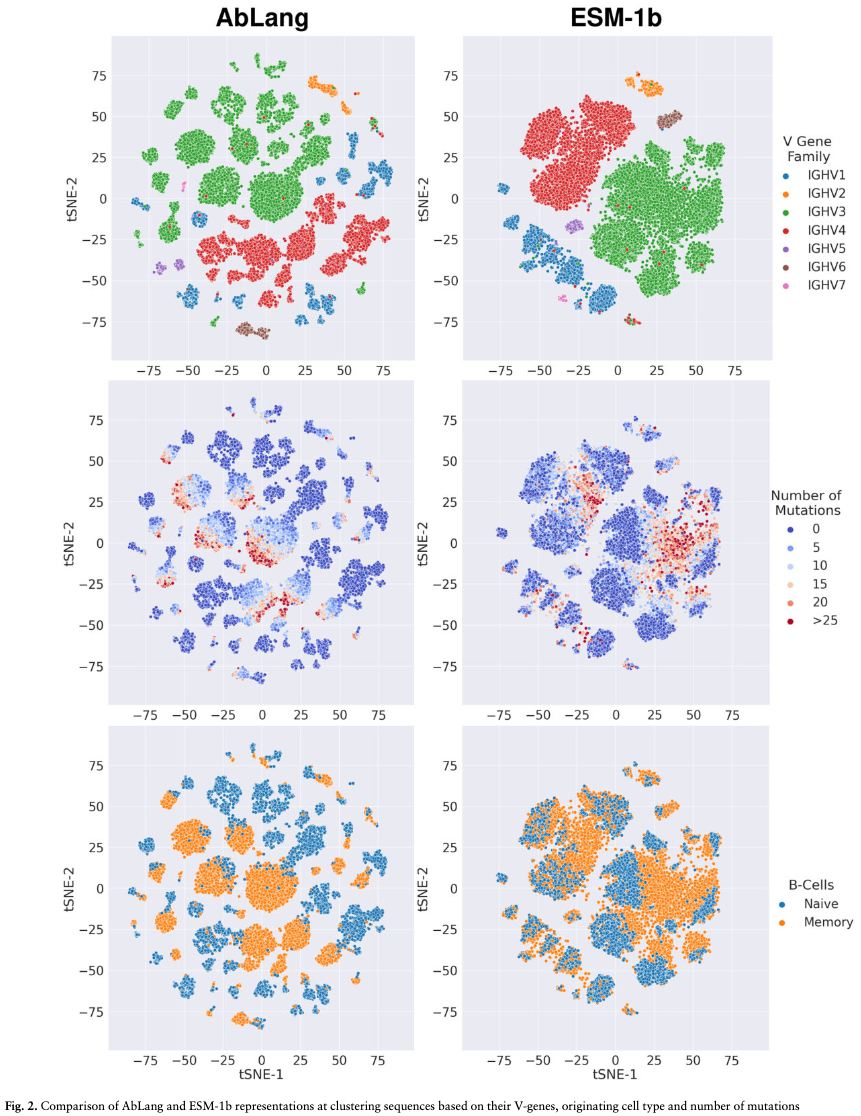 Ref (2)
See also
- PLM-derived antibody representations can distinguish engineered from human-derived Abs
- CDR representations segregate into distinct clusters
1.
Ruffolo JA, Gray JJ, Sulam J. Deciphering antibody affinity maturation with language models and weakly supervised learning. 2021; Available from: https://arxiv.org/abs/2112.07782
2.
Olsen TH, Moal IH, Deane CM. AbLang: an antibody language model for completing antibody sequences. Bioinformatics Advances. 2022;2(1). Available from: https://doi.org/10.1093/bioadv/vbac046
3.
Jing H, Gao Z, Xu S, Shen T, Peng Z, He S, et al. Accurate prediction of antibody function and structure using bio-inspired antibody language model. Briefings in Bioinformatics. 2024;25(4). Available from: https://doi.org/10.1093/bib/bbae245
4.
Leem J, Mitchell LS, Farmery JHR, Barton J, Galson JD. Deciphering the language of antibodies using self-supervised learning. Patterns. 2022;3(7):100513. Available from: https://doi.org/10.1016/j.patter.2022.100513