Summary
Confidence metrics like ipTM from diffusion-based protein structure prediction can be improved with relatively small changes in the conditioning probabilities (1). This was observed when using this as an objective for diffusion guidance.
Figures
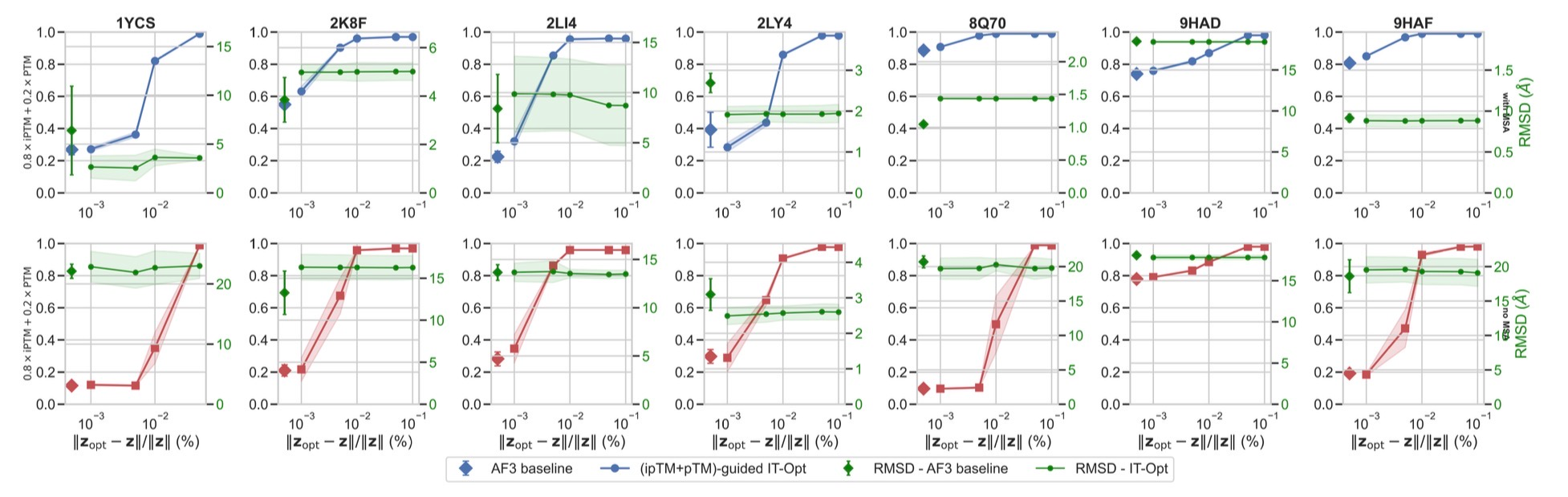
Ref (1)
See also
- Diffusion-based structure prediction can be steered by modifying the conditioning embeddings rather than the latent space, and such embeddings can be used for subsequent iterations
- Protein structure prediction and design metrics don’t correlate with expression probability
- Sequence- and structure-derived ML quality metrics from ML do not correlate with each other
- pLDDT correlates with number of homologous sequences provided during runtime
- Protein structure prediction and design confidence metrics do not correlate with binding affinity
- Protein folding neural networks cannot predict protein stability
1.
Maddipatla A, Rzayev A, Pegoraro M, Pacesa M, Schanda P, Marx A, et al. Inference-time optimization for experiment-grounded protein ensemble generation. 2026; Available from: https://arxiv.org/abs/2602.24007