Summary
Raw confidence from protein folding neural networks is not a general predictor of protein stability. Mutation-induced ddG values show little or no correlation with changes in pLDDT (1), and high-pLDDT designs can still unfold during Hamiltonian Replica-exchange molecular dynamics (2). The networks nonetheless contain some stability-related signal: AlphaFold2 pLDDT correlates with stability within restricted fold families (3), and ESMFold pLDDT moderately discriminates experimentally successful from unsuccessful monomer designs (4). Dedicated downstream models can also predict ddG from AlphaFold structures about as accurately as from experimental structures (5). RMSD itself does not correlate with stability, although (6) showed that a custom strain score was able to predict this with some success.
Figures
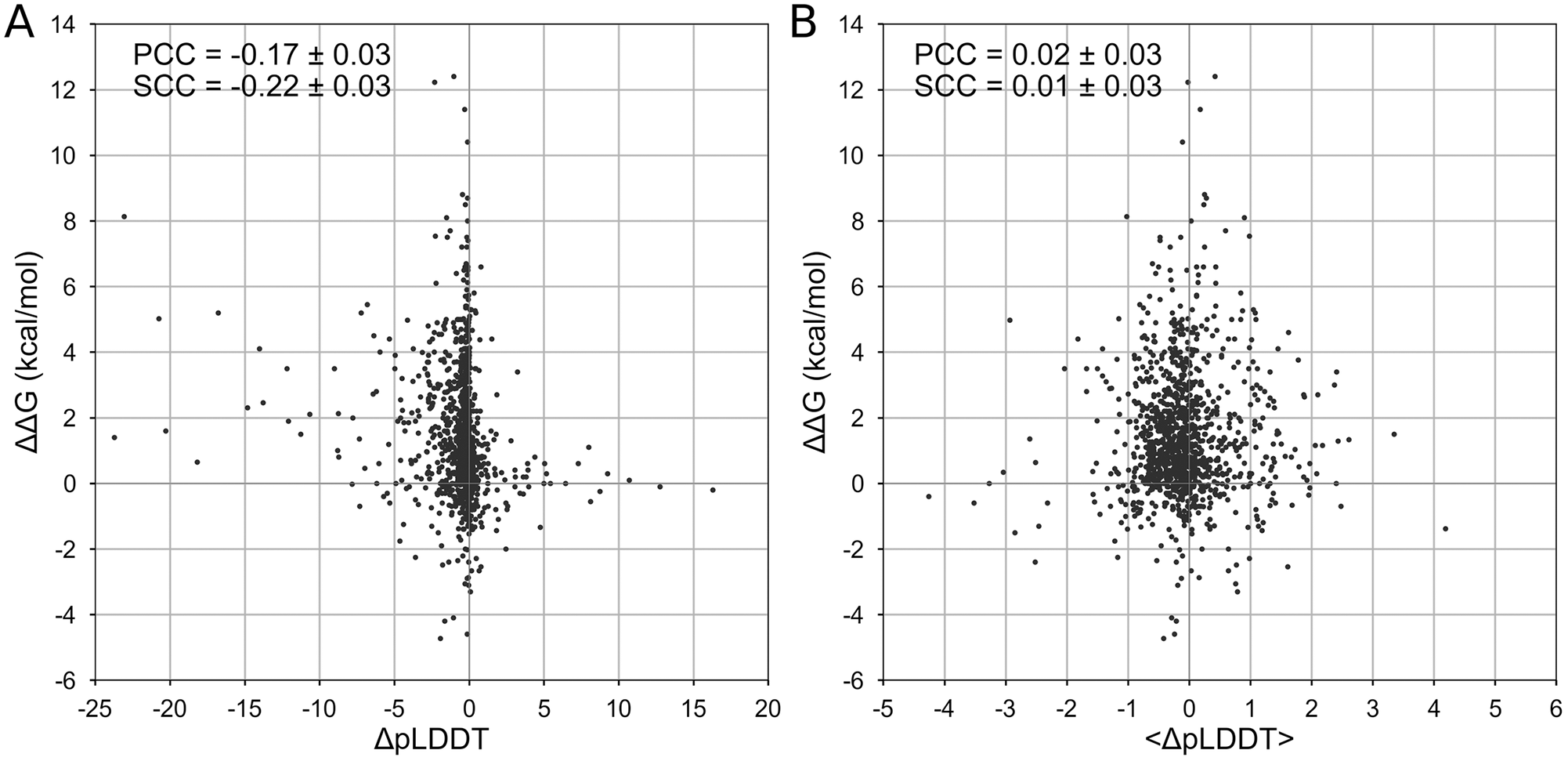 Ref (1)
See also
- High-pLDDT designs can be insoluble
- Protein structure prediction and design confidence metrics do not correlate with binding affinity
- ESMFold pLDDT weakly correlates with intra-family differences in stability and experimental success, but not differences in cooperativity