Summary
Distance between mean-pooled PLM embeddings does not correlate with structural difference (1). That said, PLMs do learn structural homology that is non-obvious from sequence on some level (2,3).
Figures
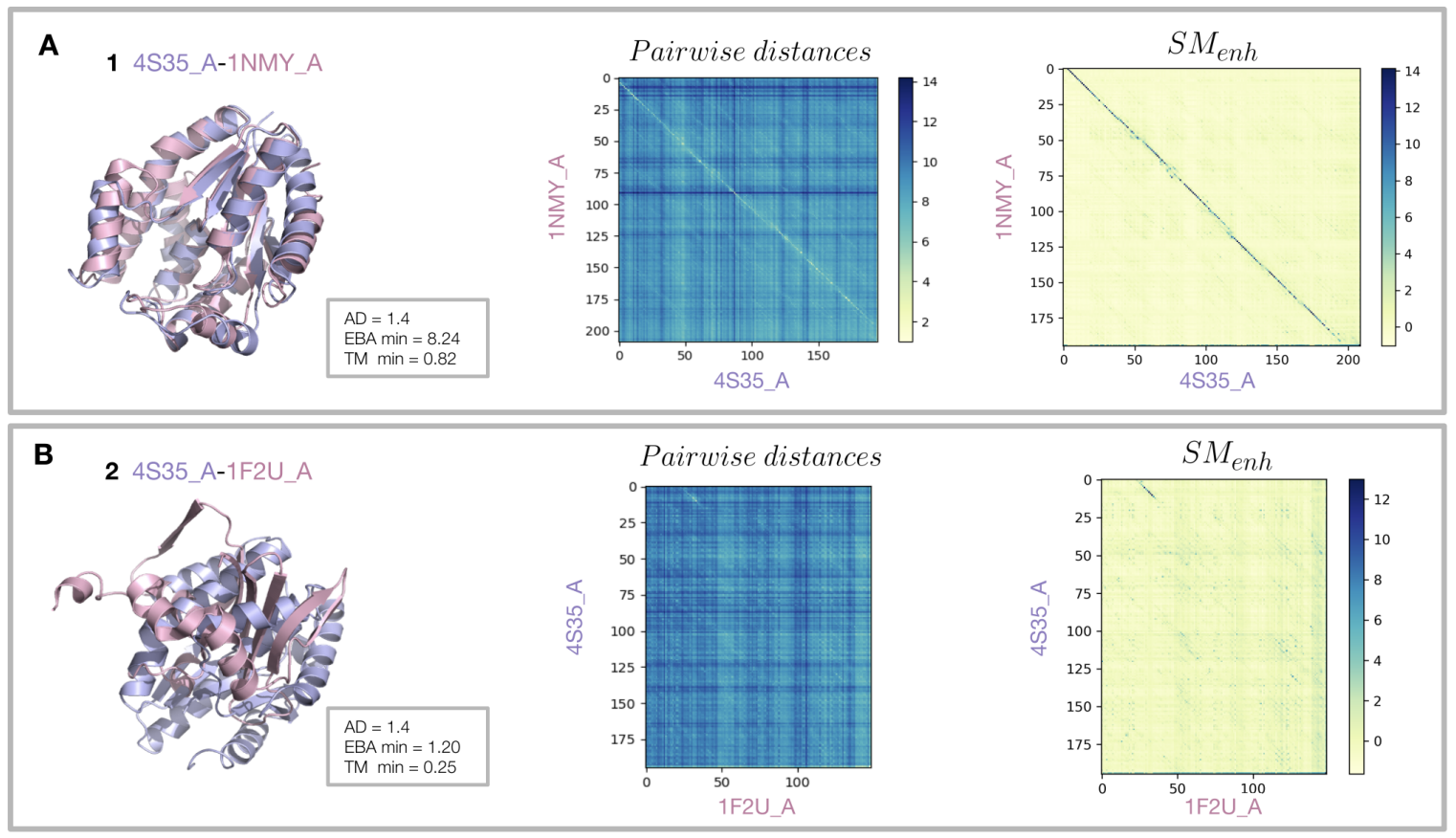
Figure 3 from (1); AD=average distance
See also
- Distance between PLM representations of two proteins correlates with functional dissimilarity
- PLM embeddings contain enough information to align proteins without fine-tuning
- Protein language model embeddings are more predictive of homology than catalytic efficiency
1.
Pantolini L, Studer G, Pereira J, Durairaj J, Tauriello G, Schwede T. Embedding-based alignment: combining protein language models with dynamic programming alignment to detect structural similarities in the twilight-zone. Bioinformatics. 2024;40(1). Available from: https://doi.org/10.1093/bioinformatics/btad786
2.
Kilinc M, Jia K, Jernigan RL. Improved global protein homolog detection with major gains in function identification. Proceedings of the National Academy of Sciences. 2023;120(9). Available from: https://doi.org/10.1073/pnas.2211823120
3.
Rives A, Meier J, Sercu T, Goyal S, Lin Z, Liu J, et al. Biological structure and function emerge from scaling unsupervised learning to 250 million protein sequences. Proceedings of the National Academy of Sciences. 2021;118(15). Available from: https://doi.org/10.1073/pnas.2016239118