Summary
The BLOSUM62 matrix has been used to restrict mutagenesis of antibodies (1), and its usefulness varies by molecule. BLOSUM-guided mutagenesis has been shown to lead to greater binding likelihood than protein language models and inverse folding models (2) in Trastuzumab. Another report showed the opposite result (3). It may come down to the level of optimization already present in the starting sequence.
Figures
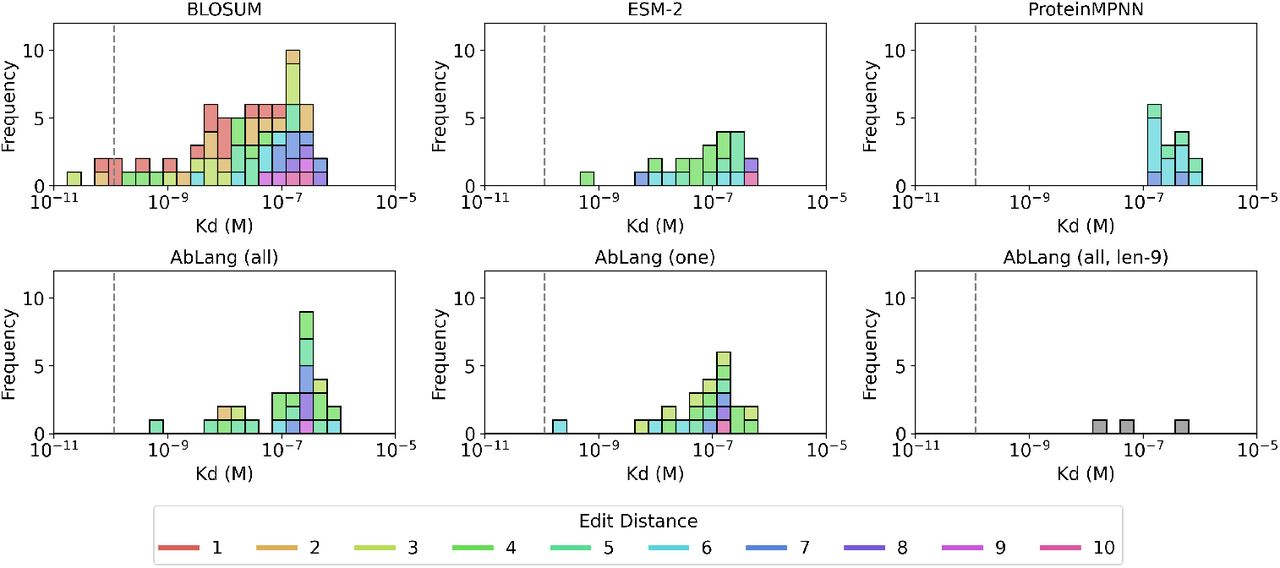 Ref (2)
1.
Makowski EK, Kinnunen PC, Huang J, Wu L, Smith MD, Wang T, et al. Co-optimization of therapeutic antibody affinity and specificity using machine learning models that generalize to novel mutational space. Nature Communications. 2022;13(1). Available from: https://doi.org/10.1038/s41467-022-31457-3
2.
Chinery L, Hummer AM, Mehta BB, Akbar R, Rawat P, Slabodkin A, et al. Simple computational methods can outperform deep learning in designing diverse, binder-enriched antibody libraries. openRxiv; 2024. Available from: https://doi.org/10.1101/2024.03.26.586756
3.
Li L, Gupta E, Spaeth J, Shing L, Jaimes R, Engelhart E, et al. Machine learning optimization of candidate antibody yields highly diverse sub-nanomolar affinity antibody libraries. Nature Communications. 2023;14(1). Available from: https://doi.org/10.1038/s41467-023-39022-2