Interferons are a type of cytokine that interrupt protein production in cells.
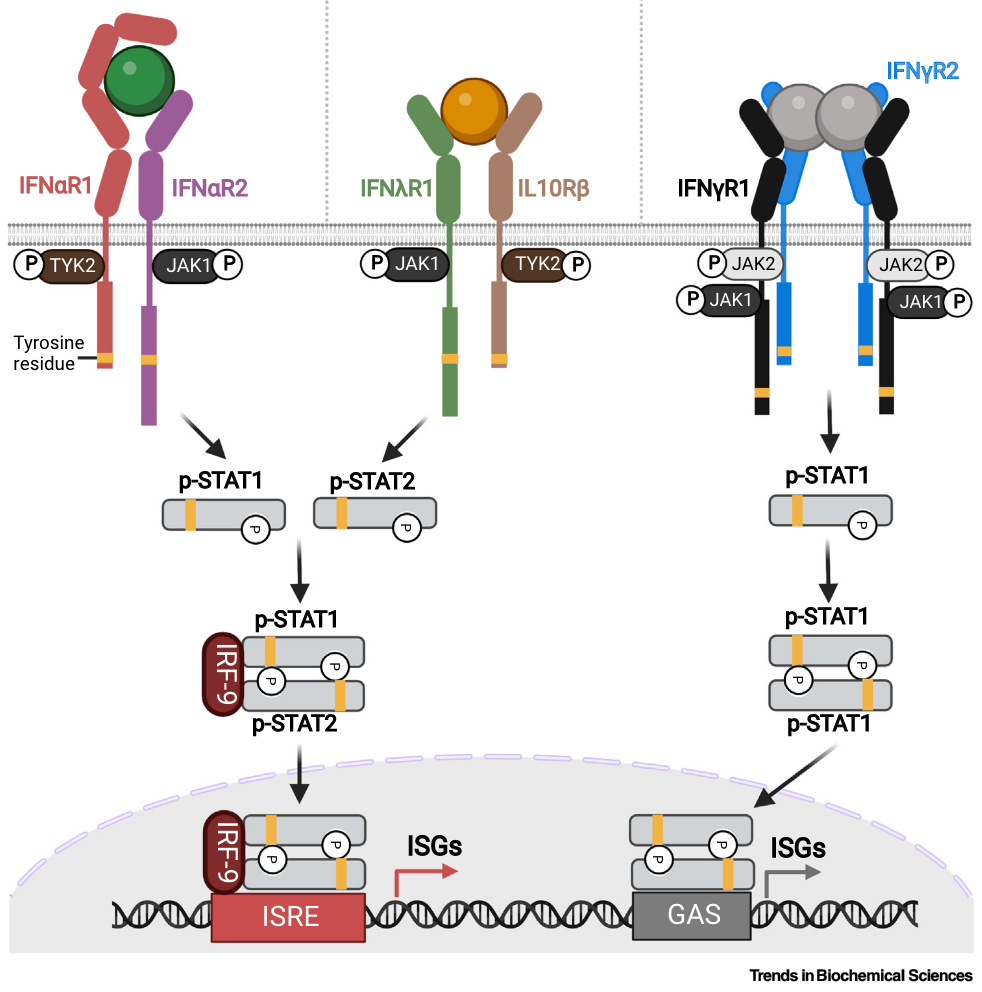 Ref (1)
Type I IFN
Characterized by:
- Antiviral activity
- Anti-proliferative activity
- Differentiation of B cells
- TH17 response
- Maturation and activation of dendritic cells
- Interferon receptors are ubiquitously expressed, and this can be a problem.
Interferon alpha
- Approved in 1986 by FDA for the treatment of several hematological malignancies like chronic myeloid leukemia chronic myeloid leukemia.
Interferon beta
- Approved for multiple sclerosis in 1996.
- Masked versions have been created and tested.
Type II IFN
Characterized by:
- Antiviral activity
- Anti-proliferative activity
- CD8+ cytotoxic T cells and Natural Kller cells effector function
- Differentiation of M1-Macrophages
- MHC-I and MHC-II presentation
Interferon gamma
Homodimeric, although single-chain versions have been engineered. Approved by FDA in 1990 for granulomatous disease. Treatment of cancer cells with IFN-gamma reduced expression of PD-L1 but not MHC-I.
Type III IFN
Characterized by:
- Antiviral activity
- Anti-proliferative activity
- Mucosal immunity These signal through the same pathway as type I interferons, but their receptor expression is limited to specific cell types. However, they have lower signal potency.
Interferon lambda-3
An engineered version called H11 improved affinity to receptor complex by 150-fold (Mendoza et al Immunity 2017), leading to increased antiproliferative abilities relative to WT.
1.
Aung T, Grubbe WS, Nusbaum RJ, Mendoza JL. Recent and future perspectives on engineering interferons and other cytokines as therapeutics. Trends in Biochemical Sciences. 2023;48(3):259–73. Available from: https://doi.org/10.1016/j.tibs.2022.09.005