Cytokines are signaling molecules involved in inflammation. They include Interferons, Interleukins, Chemokines, colony-stimulating factors, Tumor necrosis factors, and Transforming growth factors. At baseline their concentration in the blood is low. Overrelease can cause a cytokine storm, triggering massive inflammation.
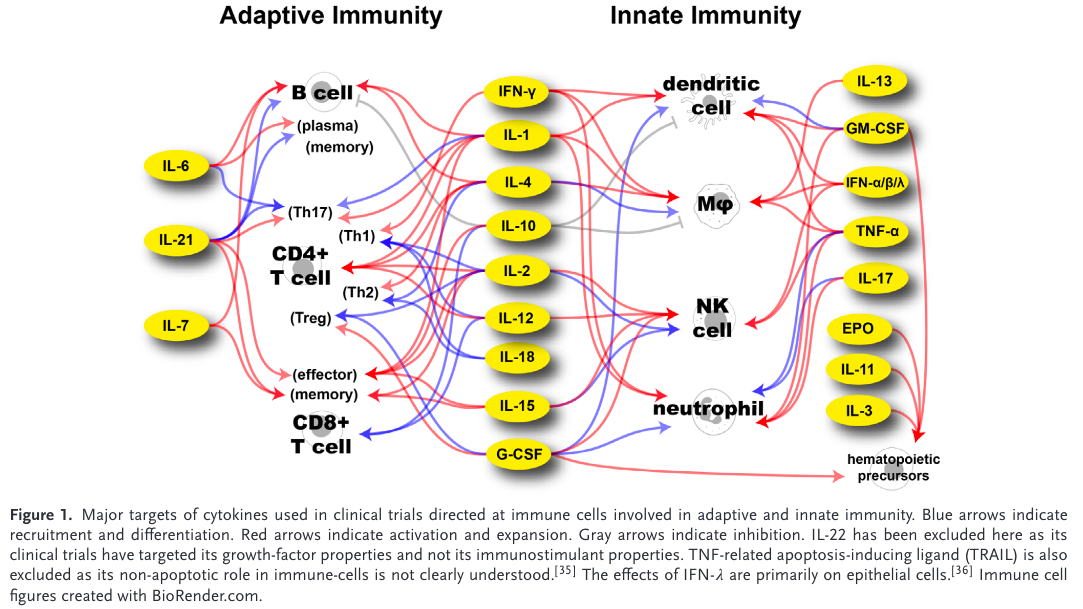 Ref (1)
Functional categorizations
- Type I cytokines, mediate development of cellular response: IL-2, IL-12, IFN-g
- Type II cytokines, mediate development of humoral response: IL-4, IL-5, IL-10, IL-13
- Regulatory cytokines, which moderate inflammation and maintain homeostasis: IL-10, TGF-b
Barriers to therapeutic application
WT cytokines are, as of 2023: “relegated to second-line therapy”, and none have been approved since the mid 1990s:
- Biological pleiotropism: context-dependent responses are variable and dynamic, and immunosuppressive and immunostimulatory effects must be decoupled.
- Poor drug-like properties:
- Short half life
- Narrow therapeutic window
- Acute toxicity and morbidity
Synthekines
Synthetic cytokines that dimerize novel receptor pairs. This has been achieved using IL-2, IL-4, and type I interferons. These can also include Nanobodies and Single chain variable fragments that mediate receptor dimerization.
Antibody-cytokine conjugates
- Fusing Fc-regions to cytokines reduces renal clearance (citation needed) and intracellular digestion via FcRn-mediated uptake. This approach has been tested with IL-2, IL-7, IL-15, IL-22. The major challenge is dealing with the fact that Fc regions are dimeric, and many cytokines are not.
- One example is a nanobody fused to IL-2 or IFN-g that targets PD-L1
- Another is the IL-10-Pavilizumab hybrid, where monomerized IL-10 was added to CDRL1.
Fusion to albumin
- This is of interest since Albumin is the most abundant protein in blood
- Fusion of IFN-g to Human serum albumin increased half-life from 4-8 hours to 144 hours
- This may cause more distribution in lymph nodes and spleen
- Can introduce steric hindrance due to 67 kDa size of HSA, reducing activity (this has been attributed to IFN-a conjugated to albumin, which retained 1.4% of in vitro activity)
- Fusing to Albumin-binding domains (which are much smaller) can counteract this
Masked cytokines
Masked IFNs get around ubiquitous expression of receptor by conjugating to soluble receptor via matrix metalloprotease-cleavable linker to conceal cytokine until it reaches tumor microenvironment, where high concentrations of the protease are present. Also done with IL-12, IL-2, IFN-beta
Miscellaneous
- Dimeric Cytokines have been monomerized using various approaches:
This note cites liberally from (2)