Summary

Not all sequences with improved activity have plausible evolutionary paths via stepwise introduction of mutations (12). One report found that a protein’s ancestry limits the range of high-fitness sequences that can be explored (4). This suggests that engineered libraries can access mutation combinations that are inaccessible to stepwise methods. Experimental evidence contradicting this claim also exists (5) (Fitness landscapes are locally smooth but globally rugged). Kirby et al found evidence against this in antibodies (6).

Details

In (1), the phosphotriesterase design PTE_5 differs from dPTE2 by four mutations that were inserted simultaneously, but does not have a plausible evolutionary path to high fitness.

In (2), where a library of 160,000 sequences saturating four positions of TrpB (tryptophan synthase) was generated, 20% of starting points had no plausible path to the optimal sequence.

(3) found that adenylate kinase variants using either zinc of hydrogen-bond networks could not be traverse by individual point mutations.

Figures
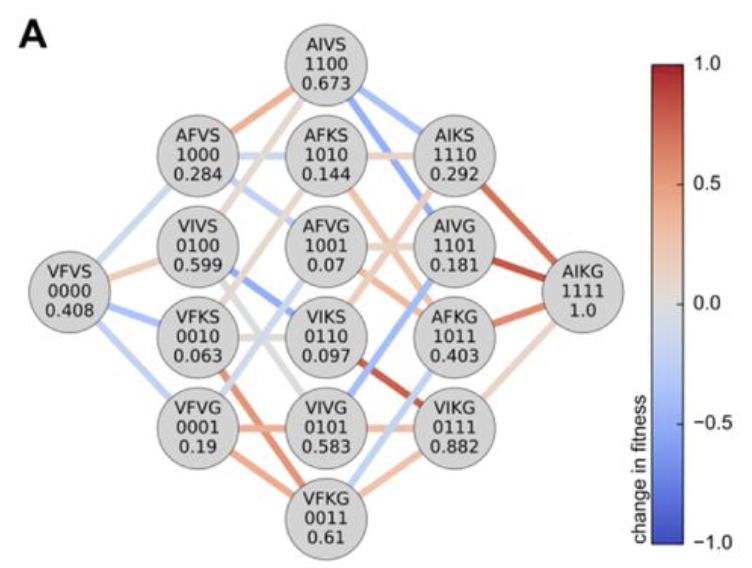
Ref (2)
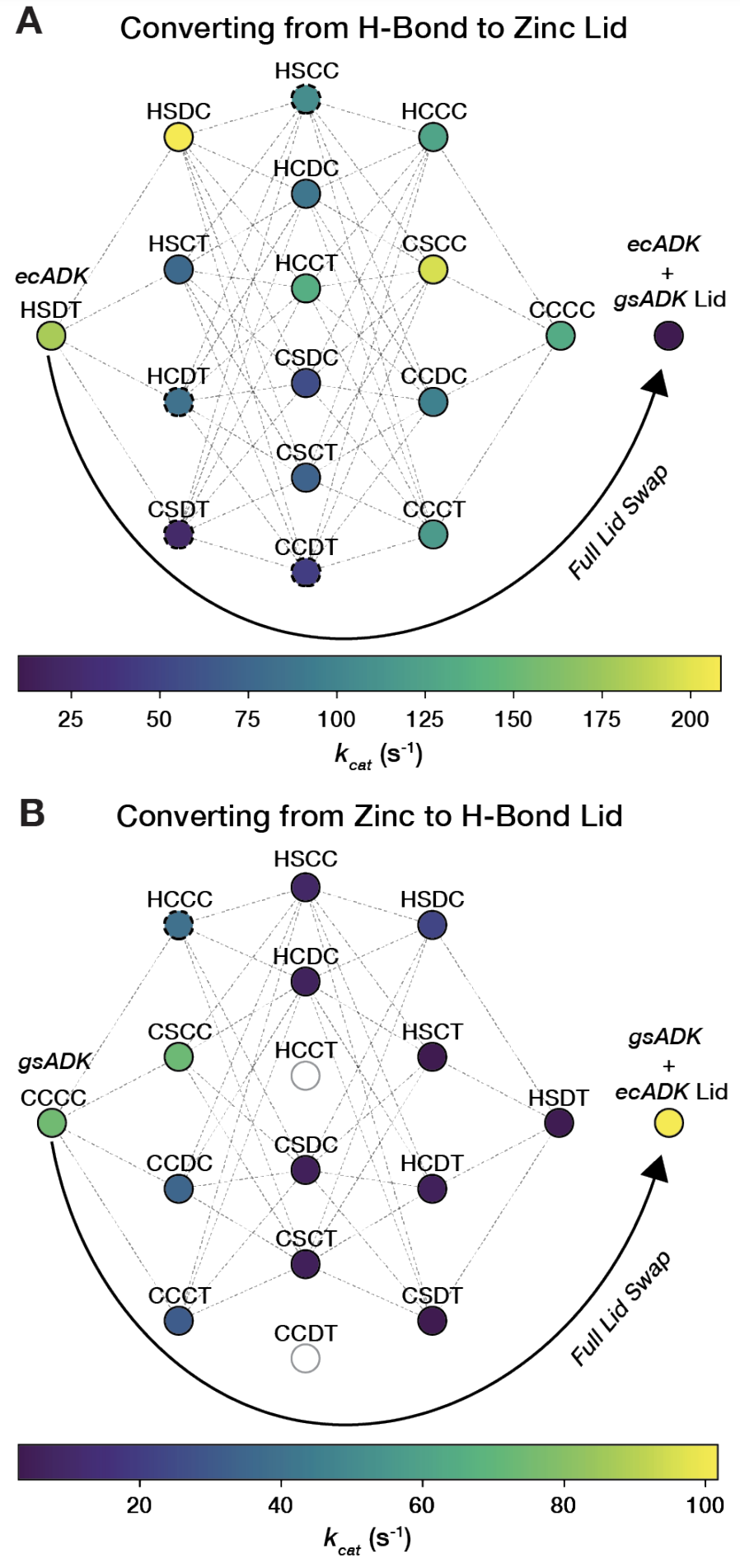
Ref (3)
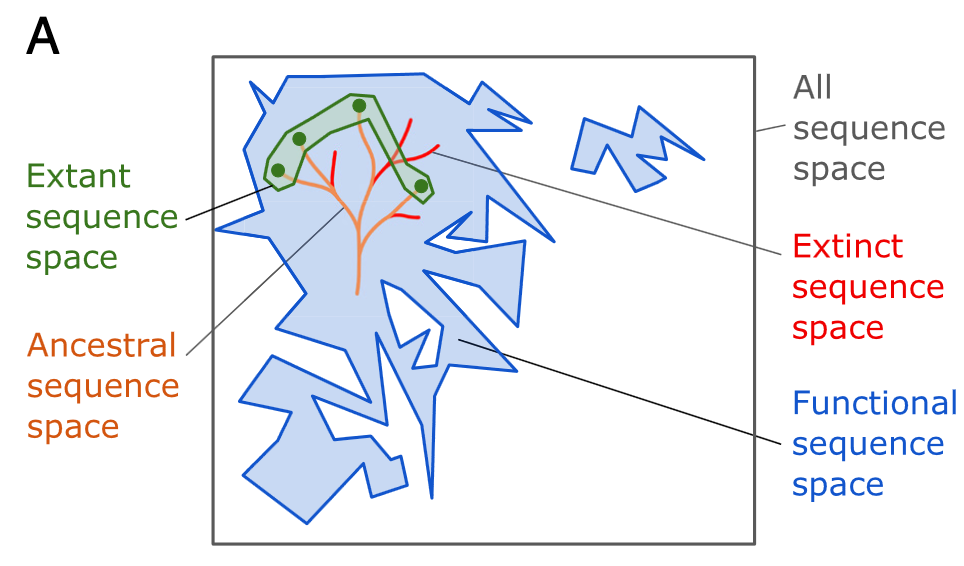
(4)

See also

1.
Khersonsky O, Lipsh R, Avizemer Z, Ashani Y, Goldsmith M, Leader H, et al. Automated Design of Efficient and Functionally Diverse Enzyme Repertoires. Molecular Cell. 2018;72(1):178-186.e5. Available from: https://doi.org/10.1016/j.molcel.2018.08.033
2.
Johnston KE, Almhjell PJ, Watkins-Dulaney EJ, Liu G, Porter NJ, Yang J, et al. A combinatorially complete epistatic fitness landscape in an enzyme active site. Proceedings of the National Academy of Sciences. 2024;121(32). Available from: https://doi.org/10.1073/pnas.2400439121
3.
Muir DF, Asper GPR, Notin P, Posner JA, Marks DS, Keiser MJ, et al. Evolutionary-scale enzymology enables exploration of a rugged catalytic landscape. Science. 2025;388(6752). Available from: https://doi.org/10.1126/science.adu1058
4.
Isakova LH, Streltsova E, Bochkareva OO, Vlasov PK, Kondrashov FA. Descent from a common ancestor restricts exploration of protein sequence space. Proceedings of the National Academy of Sciences. 2026;123(14). Available from: https://doi.org/10.1073/pnas.2532018123
5.
Papkou A, Garcia-Pastor L, Escudero JA, Wagner A. A rugged yet easily navigable fitness landscape. Science. 2023;382(6673). Available from: https://doi.org/10.1126/science.adh3860
6.
Kirby MB, Petersen BM, Faris JG, Kells SP, Sprenger KG, Whitehead TA. Retrospective SARS-CoV-2 human antibody development trajectories are largely sparse and permissive. Proceedings of the National Academy of Sciences. 2025;122(4). Available from: https://doi.org/10.1073/pnas.2412787122