Summary
Mutations obtained by antibodies during affinity maturation show epistasis in biophysical properties like expression and polyspecificity, but not binding (1,2). In a study by (1) on 12 anti-SARS-CoV-2 antibodies using deep mutational scanning and yeast display., no combination of two point mutations showed greater than 30% difference in binding affinity compared to the sum of two individual mutations in isolation. Likewise, (2) saw linear models explain 80-90% of single-antigen binding in their data. However, the latter saw that second-order models were necessary to model expression and polyspecificity.
Figures
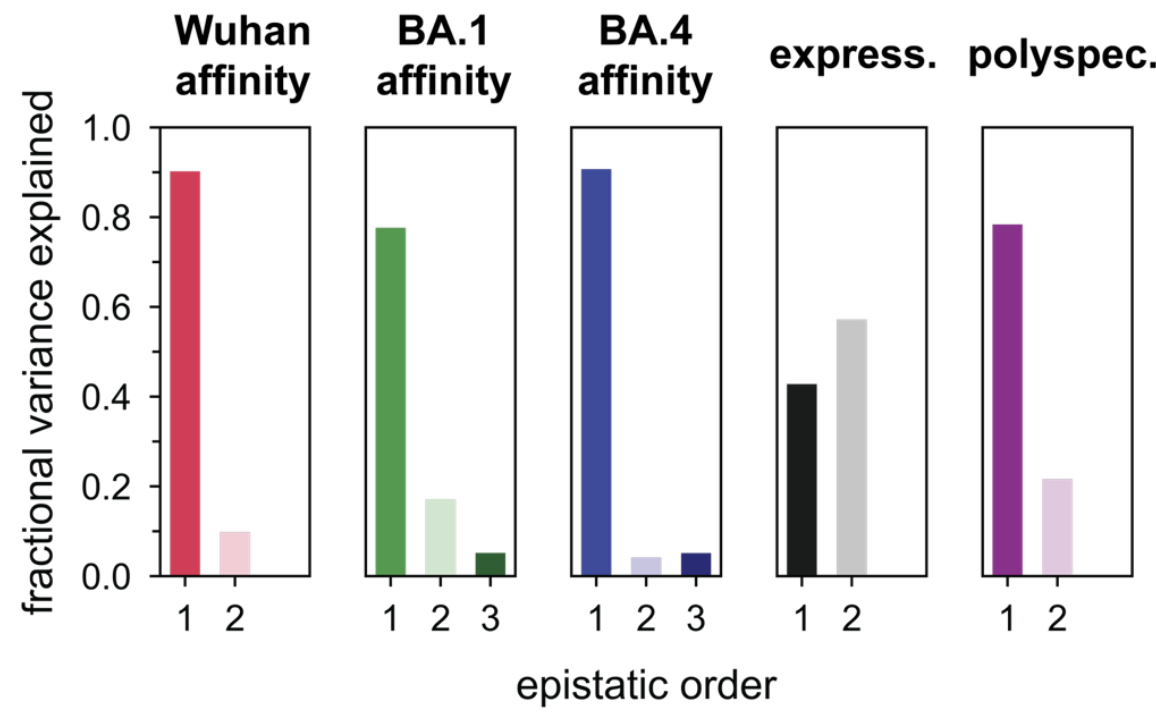 Ref (2)
See also
- Not all sequences with improved activity have plausible evolutionary paths via stepwise introduction of mutations
- Epistasis is rare during evolution
1.
Kirby MB, Petersen BM, Faris JG, Kells SP, Sprenger KG, Whitehead TA. Retrospective SARS-CoV-2 human antibody development trajectories are largely sparse and permissive. Proceedings of the National Academy of Sciences. 2025;122(4). Available from: https://doi.org/10.1073/pnas.2412787122
2.
Tharp CR, Catalano C, Khalifeh A, Ghaffari-Kashani S, Huang R, Kang G, et al. Biophysical trade-offs in antibody evolution are resolved by conformation-mediated epistasis. openRxiv; 2026. Available from: https://doi.org/10.64898/2026.03.12.711465