Summary
Changing AlphaFold2’s starting position for the protein structure from the “black hole” initialization dramatically improves the Structure prediction accuracy (1,2). Monomer prediction was improved by starting from an initial guess (like a Rosetta model), and (3) used this to design dynamic proteins in multiple conformations. (4) modeled homo-oligomers starting from the structure of a monomer.
Figures
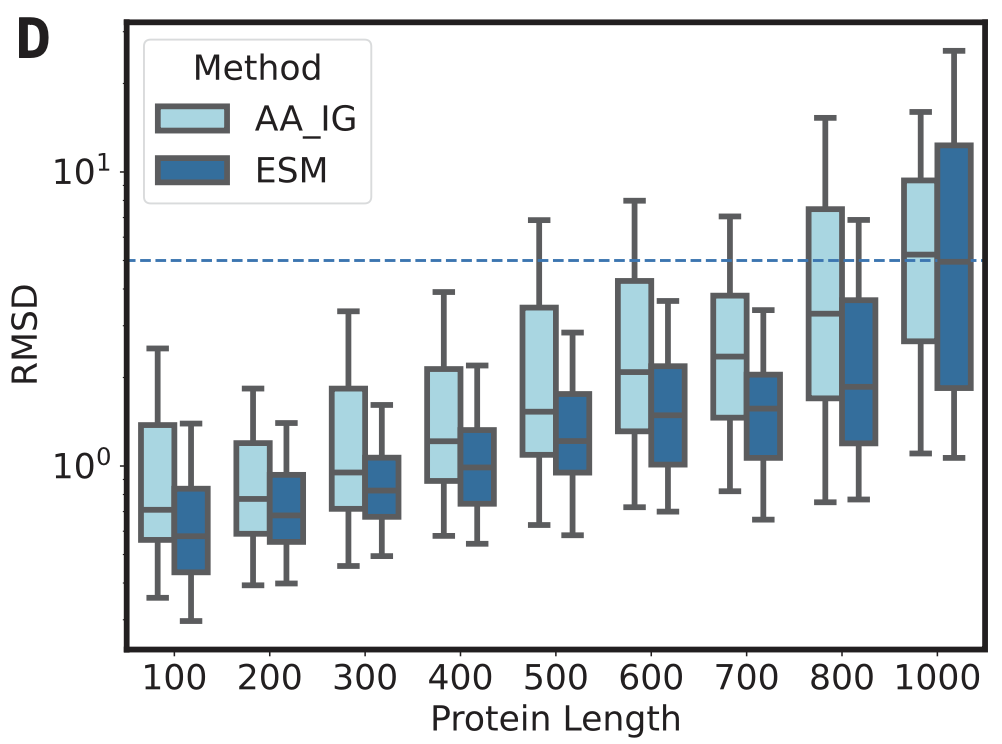
Ref (2); AA_IG refers to AlphaFold2 with initial guess; ESM refers to ESMFold
1.
Bennett NR, Coventry B, Goreshnik I, Huang B, Allen A, Vafeados D, et al. Improving de novo protein binder design with deep learning. Nature Communications. 2023;14(1). Available from: https://doi.org/10.1038/s41467-023-38328-5
2.
Frank C, Khoshouei A, Fuβ L, Schiwietz D, Putz D, Weber L, et al. Scalable protein design using optimization in a relaxed sequence space. Science. 2024;386(6720):439–45. Available from: https://doi.org/10.1126/science.adq1741
3.
Praetorius F, Leung PJY, Tessmer MH, Broerman A, Demakis C, Dishman AF, et al. Design of stimulus-responsive two-state hinge proteins. Science. 2023;381(6659):754–60. Available from: https://doi.org/10.1126/science.adg7731
4.
Schweke H, Pacesa M, Levin T, Goverde CA, Kumar P, Duhoo Y, et al. An atlas of protein homo-oligomerization across domains of life. Cell. 2024;187(4):999-1010.e15. Available from: https://doi.org/10.1016/j.cell.2024.01.022