ESMFold is a structure prediction method that relies on the ESM2-3B protein language model. Its design includes the structure module as well as a stripped-down Evoformer. It was trained on several million AlphaFold2 models in addition to the PDB.
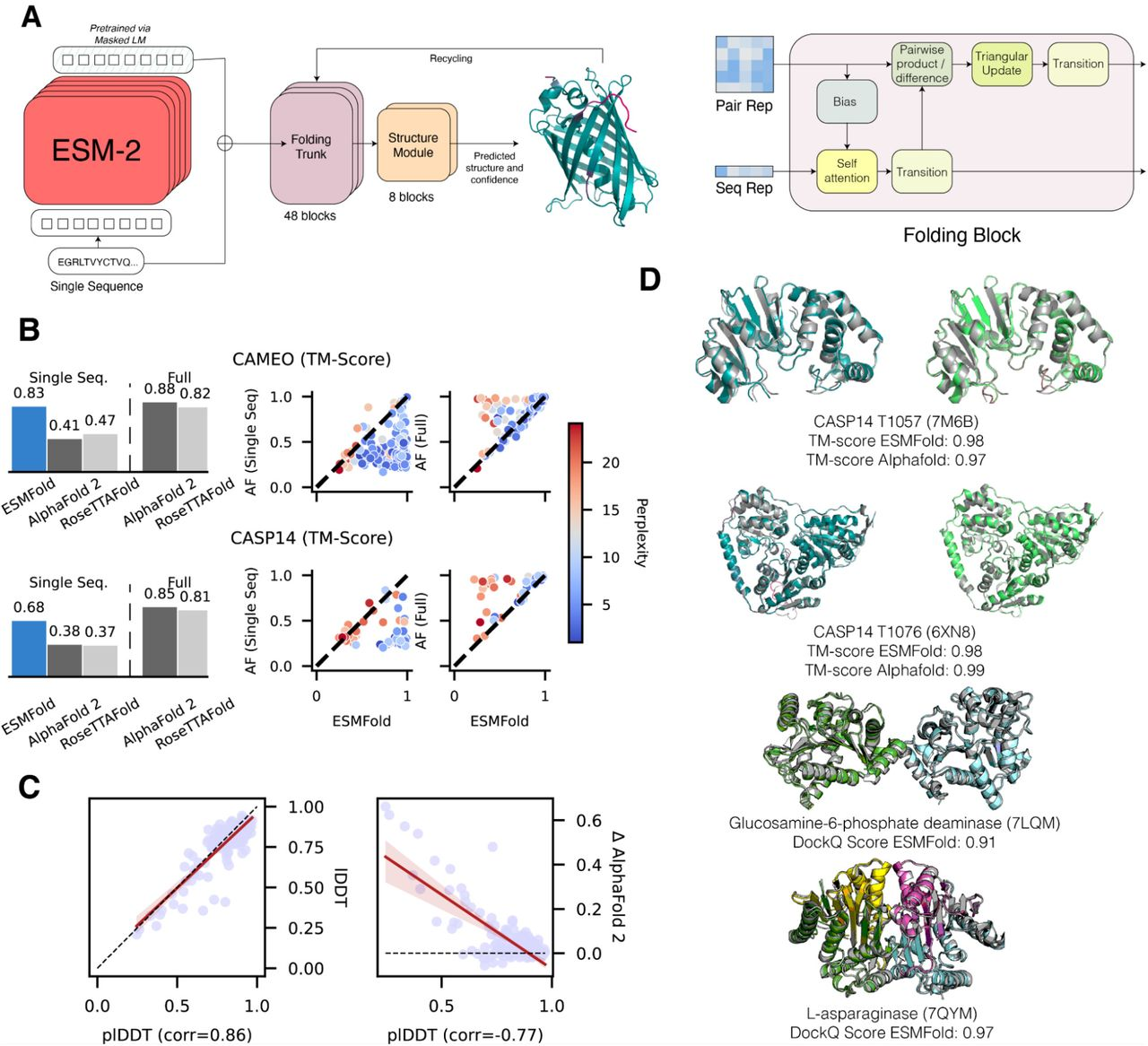 Figure 2 from Lin et al. (1)
Notes
- ESMFold hallucinates more realistic sequences than AlphaFold2 (2). No fine-tuning is required for family- or fold-specific design, unlike ProGen (Base PLMs must usually be fine-tuned to generate functionally active sequences).
- ESMFold has a tendency to fold everything (3). This can be more closely checked by comparing the folded structure to the contacts predicted by the language model.
- Inversion of ESMFold has allowed high-pLDDT paths to be identified for conformational interconversion (4).
- ESMFold can validate diffusion designs with pdbTM < 0.6 and generate structures with pLDDT > 0.7 (again sequences are designed with ProteinMPNN at temperature = 0.1; Yim et al. (5)).
- ESMFold has been used to rank clinical pathogenicity of CFTR mutations (6).
1.
Lin Z, Akin H, Rao R, Hie B, Zhu Z, Lu W, et al. Evolutionary-scale prediction of atomic-level protein structure with a language model. Science. 2023;379(6637):1123–30. Available from: https://doi.org/10.1126/science.ade2574
2.
Jeliazkov JR, del Alamo D, Karpiak JD. ESMFold Hallucinates Native-Like Protein Sequences. openRxiv; 2023. Available from: https://doi.org/10.1101/2023.05.23.541774
3.
Hermosilla AM, Berner C, Ovchinnikov S, Vorobieva AA. Validation of de novo designed water-soluble and transmembrane proteins by in silico folding and melting. openRxiv; 2023. Available from: https://doi.org/10.1101/2023.06.06.543955
4.
del Alamo D, Jeliazkov JR, Truan D, Karpiak JD. Conformational sampling and interpolation using language-based protein folding neural networks. openRxiv; 2023. Available from: https://doi.org/10.1101/2023.12.16.571997
5.
Yim J, Trippe BL, De Bortoli V, Mathieu E, Doucet A, Barzilay R, et al. SE(3) diffusion model with application to protein backbone generation. In: Proceedings of the 40th International Conference on Machine Learning. PMLR; 2023. p. 40001–39. (Proceedings of Machine Learning Research; vol. 202). Available from: https://proceedings.mlr.press/v202/yim23a.html
6.
Drysdale E. A multitask neural network trained on embeddings from ESMFold can accurately rank order clinical outcomes for different cystic fibrosis mutations. openRxiv; 2023. Available from: https://doi.org/10.1101/2023.10.26.564274