Summary
Immunomodulatory antibodies, which modulate specific signaling pathways, achieve high signal transduction with lower affinity, specifically with high off-rate (1). This was verified on the CD40 receptor, TNF receptor 4-1BB, and PD-1 by Yu et al, on the Fas TNF receptor by (2), and the erythropoietin receptor by (3). The latter two studies found that specifically needs to be attenuated to improve functional activity. The mechanism requires bivalent binding and is proposed to involve clustering of receptors.
Details
A companion explainer about T-cell receptors describes it as follows:
“low binding affinities enable a ligand to bind for long enough to enable the receptor to initiate a consecutive series of signalling steps, yet for a short enough length of time to enable one ligand molecule to subsequently engage many receptors to amplify the signal”
Figures
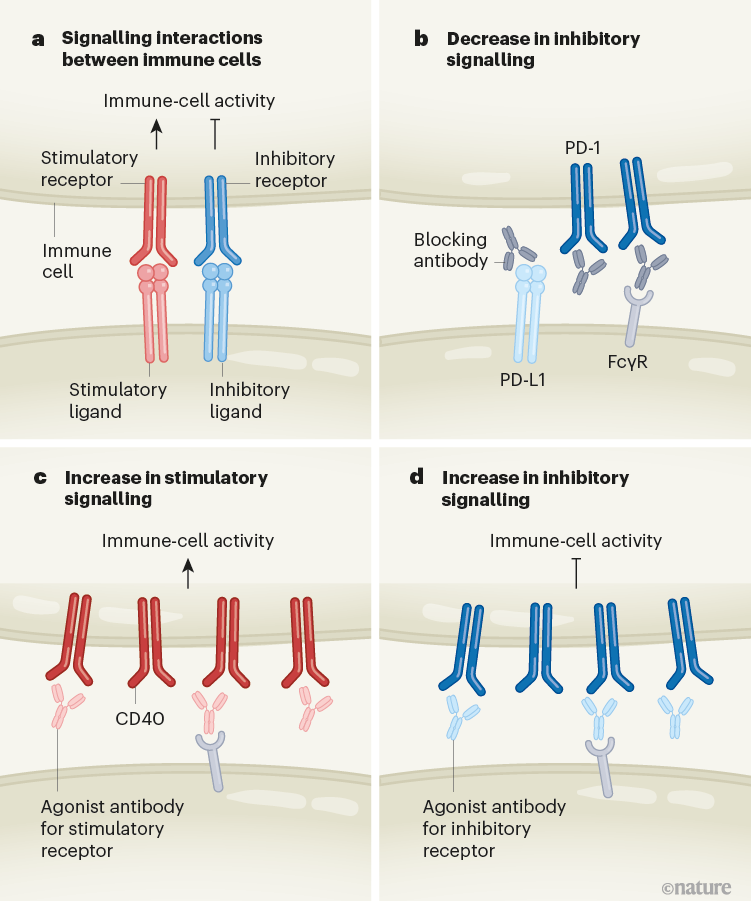 Ref (4)
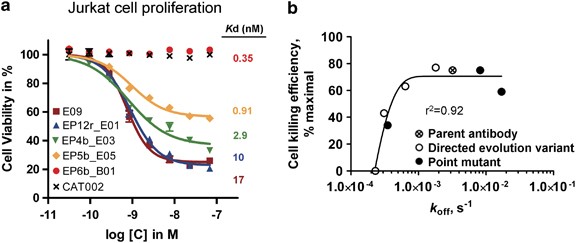 Ref (2)