Summary
Stabilization can sometimes improve the affinity of antibodies and nanobodies, but the relationship between stability and affinity is non-monotonic. There are several examples of affinity improvements using framework-targeting stabilizing mutations (1–2), while destabilizing mutations have also been shown to improve affinity (3).
Figures
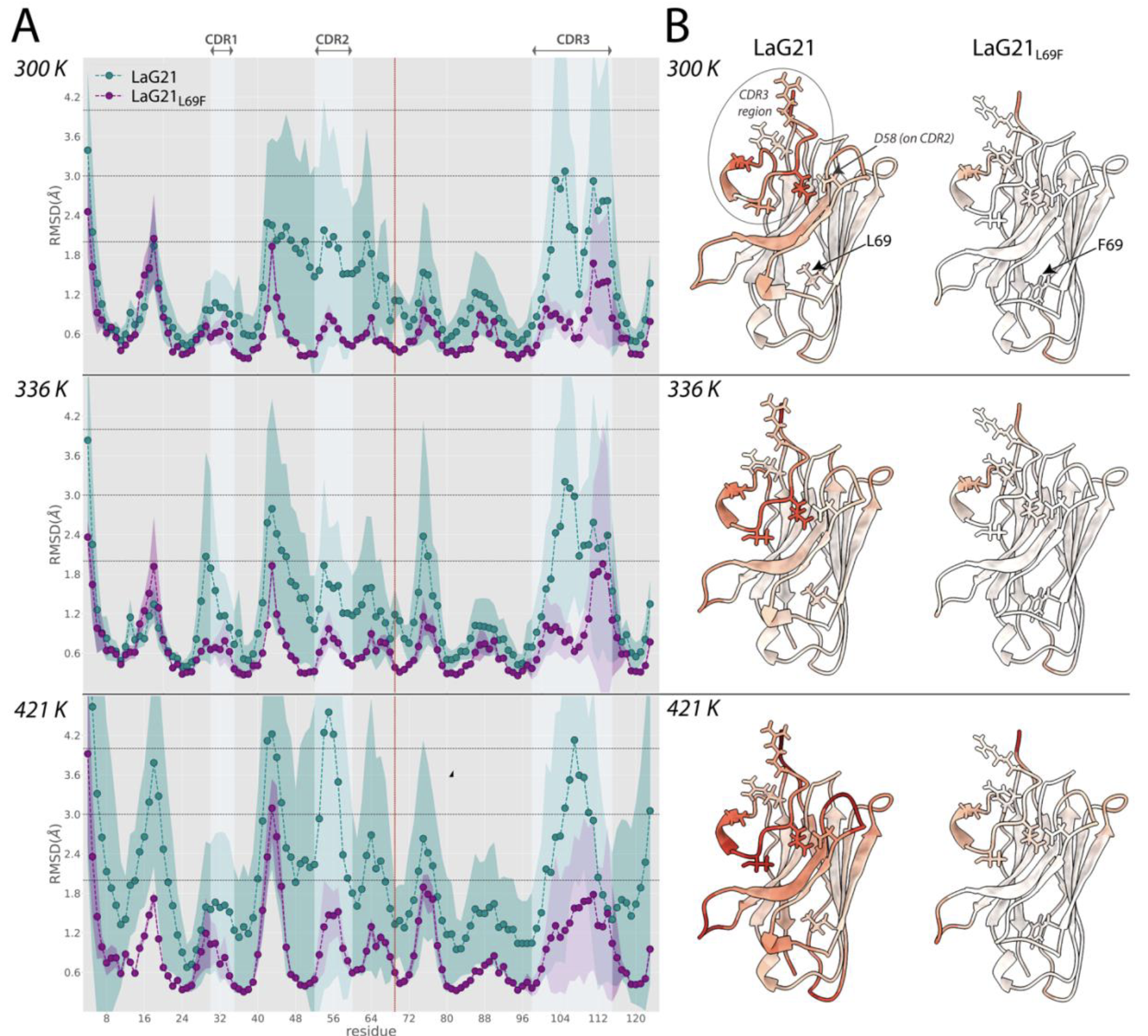 Ref (3) — teal and purple are the non-stabilized and stabilized nanobodies, respectively
See also
- Stability-activity trade-off during enzyme design and evolution is highly local and not global
- Mutations that give rise to new functions are not more destabilizing than mutations in general
- Conformational entropy in antibodies is inversely proportional to antigen affinity
1.
Hie BL, Shanker VR, Xu D, Bruun TUJ, Weidenbacher PA, Tang S, et al. Efficient evolution of human antibodies from general protein language models. Nature Biotechnology. 2023;42(2):275–83. Available from: https://doi.org/10.1038/s41587-023-01763-2
2.
Shanker VR, Bruun TUJ, Hie BL, Kim PS. Unsupervised evolution of protein and antibody complexes with a structure-informed language model. Science. 2024;385(6704):46–53. Available from: https://doi.org/10.1126/science.adk8946
3.
Ketaren NE, Fridy PC, Malashkevich V, Sanyal T, Brillantes M, Thompson MK, et al. Unique mechanisms to increase structural stability and enhance antigen binding in nanobodies. Structure. 2025;33(4):677-690.e5. Available from: https://doi.org/10.1016/j.str.2025.01.019