Summary
In the repertoire studied by Shehata et al., the thermostability of antibodies decreased during affinity maturation until a threshold was reached (1). This threshold was usually reached within a few mutations, and thermostability could subsequently be increased by either introducing germline mutations (1), or with rescue mutations that bring the sequence even farther from germline precursors (2).
Figures
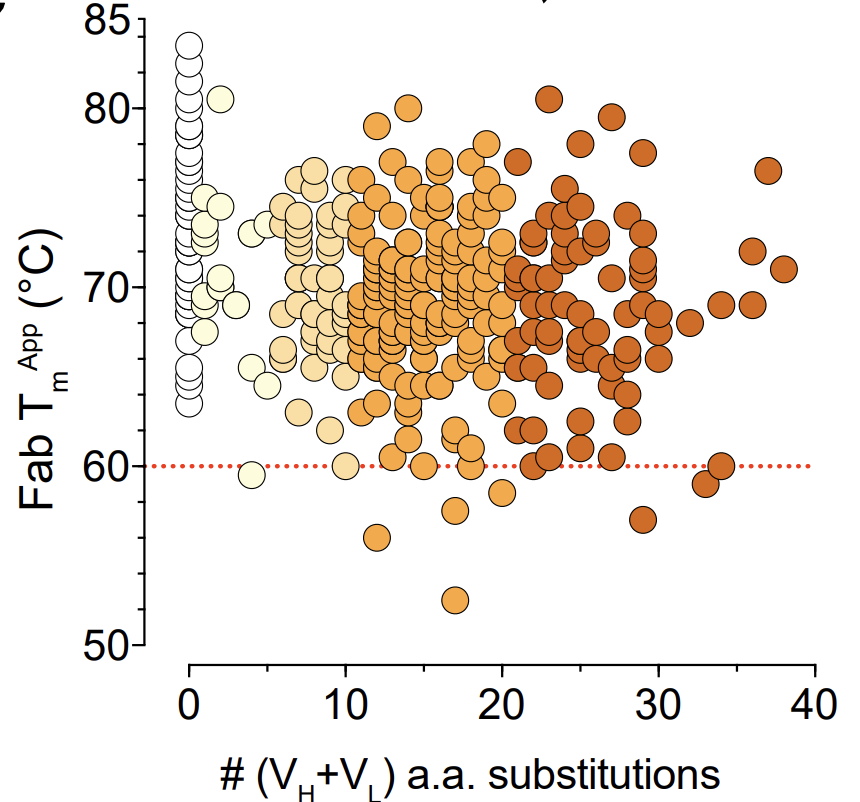 Figure 3C from (1)
See also
- Antibody thermostability is not correlated with hydrophobicity
- Antibody thermostability is not correlated with polyreactivity
- Conformational entropy in antibodies is inversely proportional to antigen affinity
- Antibody affinity can sometimes be improved by stabilization
1.
Shehata L, Maurer DP, Wec AZ, Lilov A, Champney E, Sun T, et al. Affinity Maturation Enhances Antibody Specificity but Compromises Conformational Stability. Cell Reports. 2019;28(13):3300-3308.e4. Available from: https://doi.org/10.1016/j.celrep.2019.08.056
2.
Julian MC, Li L, Garde S, Wilen R, Tessier PM. Efficient affinity maturation of antibody variable domains requires co-selection of compensatory mutations to maintain thermodynamic stability. Scientific Reports. 2017;7(1). Available from: https://doi.org/10.1038/srep45259