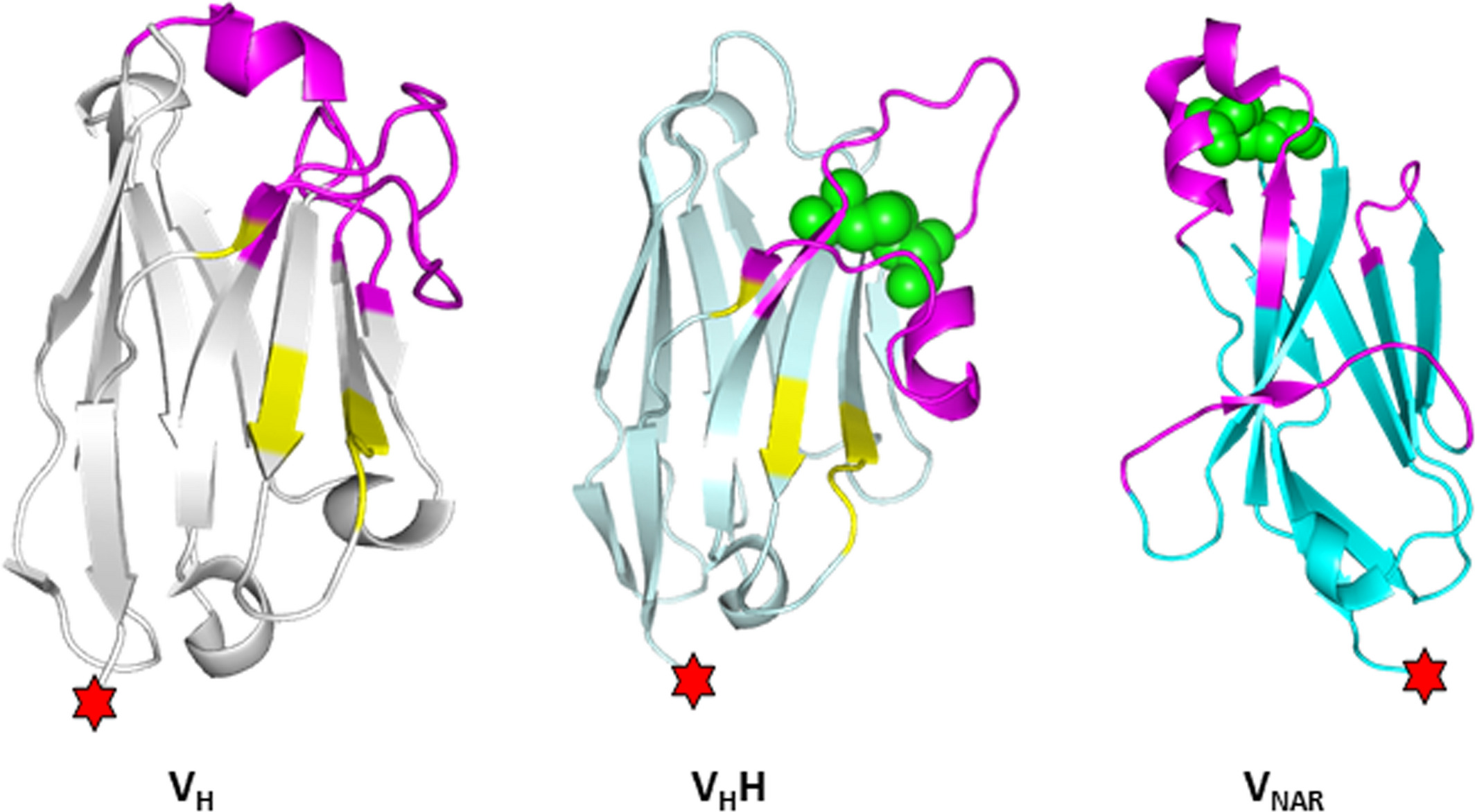
Nanobodies are single-chain antibody-like molecules (albeit 12-15kDa, or 1/10th the size). They are found in camelids such as alpacas, as well as sharks. Nanobodies from the former are abbreviated as and consist of a homodimeric heavy-only chain with two constant regions each, while those from the latter are abbreviated as and consist of five constant regions each. structures are heavy chain-like and consist of three CDR loops and an Ig domain. Camelid nanobodies account for most of the length diversity in CDRH1, which in humans and mice are almost all length 7 (1). Shark nanobodies lack CDR2 and two strands from the framework, and thus don’t resemble either heavy or light chain in humans; they are “humanized” into single-domain light chains.
General properties
- Nanobodies are more soluble than antibodies (2).