Summary
De novo designed proteins with alpha helices are more likely to fold without any homology information than those with beta sheets (1). At EMBL-EBI, Possu Huang suggested that the reliance on structure prediction as a validation tool during protein design favors helical proteins.
Figures
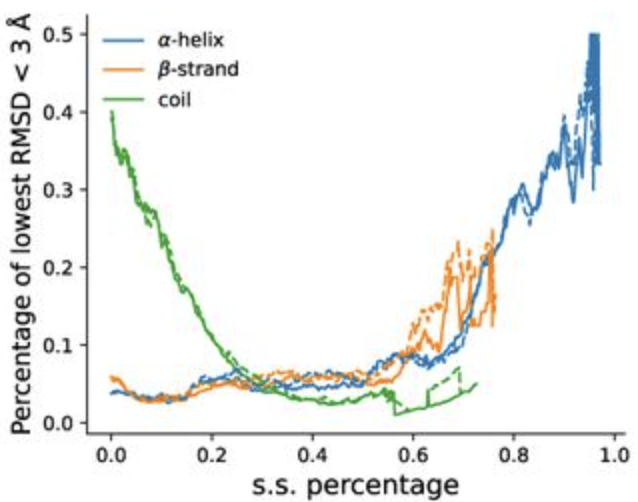 Ref (1)
See also
- Protein backbones designed by diffusion, but not by language models, have more secondary structure
- Sheets are less designable than helices
- Protein backbones designed using diffusion, but not sequence-based models, have fewer beta sheets
- The structures of shorter de novo designed sequences are easier to predict than those of longer proteins
1.
Chang L, Perez A. AlphaFold2 knows some protein folding principles. openRxiv; 2024. Available from: https://doi.org/10.1101/2024.08.25.609581