Summary
Nanobodies and normal antibodies target epitopes with similar solvent accessibility, hydrogen bonds, and contacts (1,2). However, nanobodies are able to adopt more convex paratopes, allowing binding to hard-to-reach areas such as ligand-binding sites.
Details
De (2) immunized camels with hen egg white lysozyme and found that most isolated nanobodies bound the active site, whereas murine antibodies from a previous study bound outside the active site.
Figures
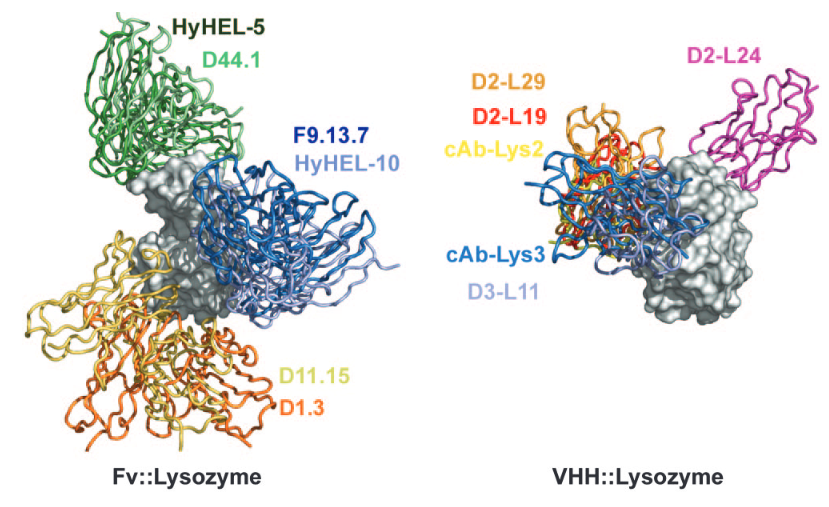 Ref (2)
See also
- Antibody-antigen binding modes are not necessarily defined by induced fit
- Nanobody CDRH3 loops are longer but more compact
1.
Gordon GL, Capel HL, Guloglu B, Richardson E, Stafford RL, Deane CM. A comparison of the binding sites of antibodies and single-domain antibodies. Frontiers in Immunology. 2023;14. Available from: https://doi.org/10.3389/fimmu.2023.1231623
2.
De Genst E, Silence K, Decanniere K, Conrath K, Loris R, Kinne J, et al. Molecular basis for the preferential cleft recognition by dromedary heavy-chain antibodies. Proceedings of the National Academy of Sciences. 2006;103(12):4586–91. Available from: https://doi.org/10.1073/pnas.0505379103