Summary
Antibody-antigen binding modes are not all defined by induced fit. Most antibodies do not change conformation upon binding, with 70% or so of CDRH3 loops moving less than 1 Å (1). Additionally, the conformational space of unbound antibodies sampled from MD simulations is a superset of all bound conformations (2), and conformational flexibility is inversely proportional to binding affinity ((3); see Conformational entropy in antibodies is inversely proportional to antigen affinity).
Figures
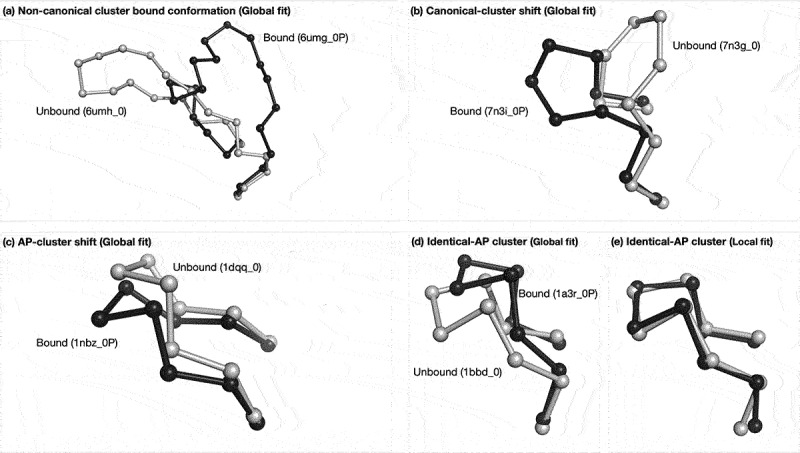 Ref (1)
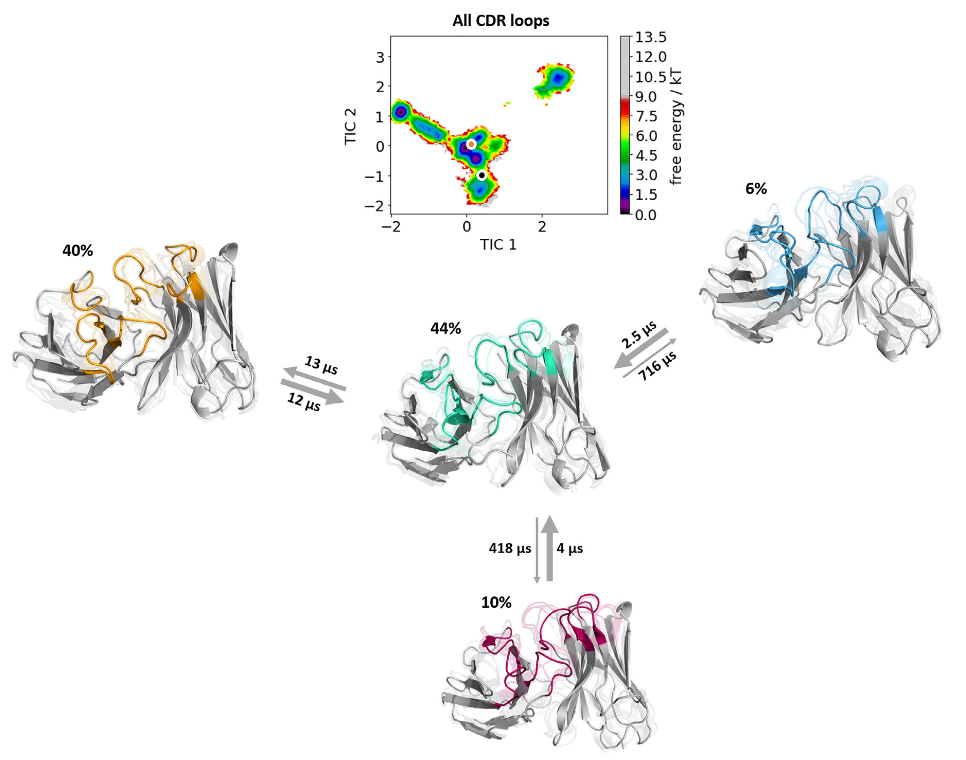 Ref (2) — unbound and bound crystal structures shown in black, respectively
See also
- Variable regions can adopt multiple interchain orientations, and these are difficult to predict
- CDRH3 conformational rigidity reduces cross reactivity
1.
Liu C, Denzler LM, Hood OEC, Martin ACR. Do antibody CDR loops change conformation upon binding? mAbs. 2024;16(1). Available from: https://doi.org/10.1080/19420862.2024.2322533
2.
Fernández-Quintero ML, Vangone A, Loeffler JR, Seidler CA, Georges G, Liedl KR. Paratope states in solution improve structure prediction and docking. Structure. 2022;30(3):430-440.e3. Available from: https://doi.org/10.1016/j.str.2021.11.001
3.
Mikolajek H, Weckener M, Brotzakis ZF, Huo J, Dalietou EV, Le Bas A, et al. Correlation between the binding affinity and the conformational entropy of nanobody SARS-CoV-2 spike protein complexes. Proceedings of the National Academy of Sciences. 2022;119(31). Available from: https://doi.org/10.1073/pnas.2205412119