Summary
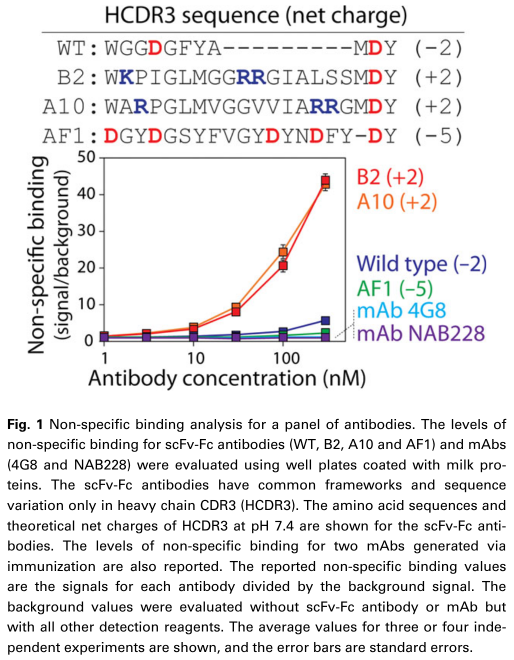
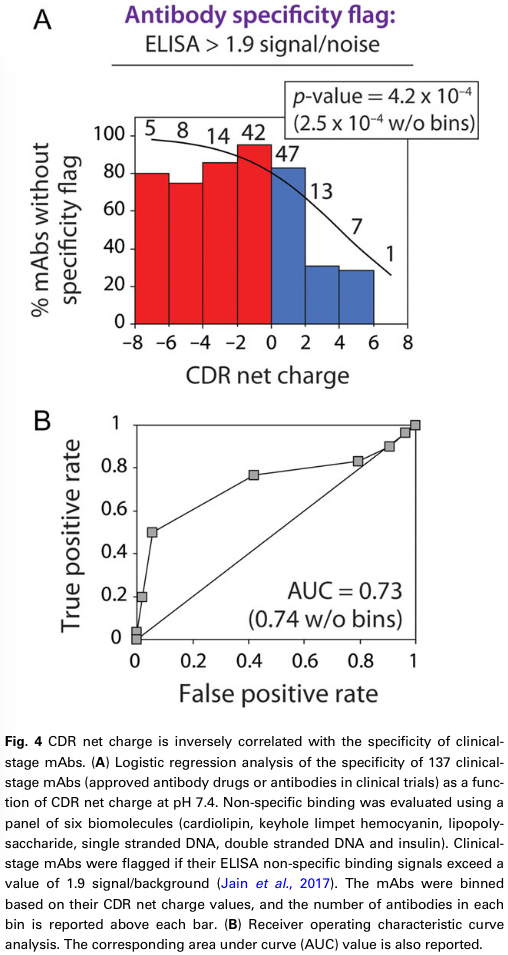
Among approved Antibodies as well as scFvs, net-positively charged CDRs had higher risk of non-specific binding (1) and binding to cells (2). This finding was independent of isoelectric point of target proteins tested, as well as the charge of the Framework region or isotype of the antibody. It appeared to be more driven by arginine rather than lysine, and they include several references to previous reports on the inclusion of arginine in antibody CDRs. Finally, it was dependent on all CDRs, not just CDRH3.
Details
Meanwhile negatively-charged CDRs had a lower risk of poor biophysical properties (see Developability). The latter include 1) refolding after thermal denaturation, 2) accelerated stability, a proxy for aggregation, 3) self-association, and 4) hydrophobicity. This was driven by the inclusion of aspartate, which were found to be more common in clinical-stage antibodies. (2) observe faster clearance for very negatively-charged antibodies (meaning a U-shaped curve).
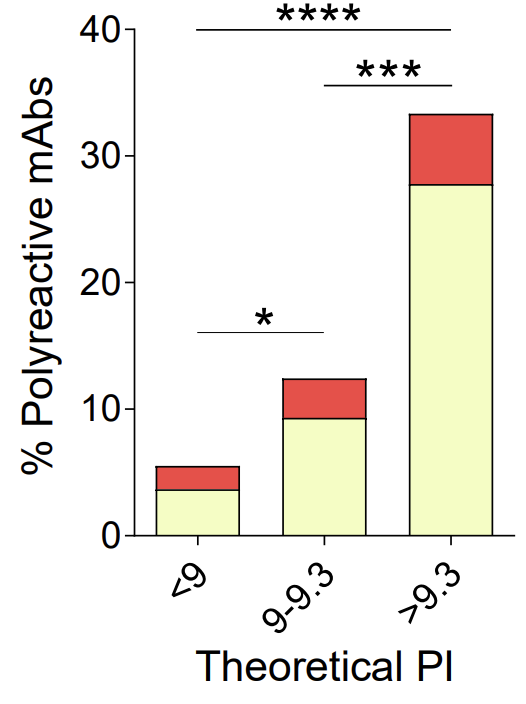
(3) found that antibodies with an isoelectric point higher than 9.3 were more polyreactive but not hydrophobic.
Relatedly, (2) found that positively charged antibodies had a higher tissue-to-plasma ratio in most tissues. These accumulate in some well-perfused organs such as liver, spleen, and kidney, but not in fat, muscle, and skin.
Figures
 Ref (1)
 Ref (1)
 Ref (3)