Summary
Protein language models encode increasingly complex biological features as representations pass through deeper layers (1). Across ESM2 and AMPLIFY models, basic physicochemical properties and linear motifs are best captured in early layers, secondary structure in subsequent layers, and domain-level semantics in middle layers. Using sparse autoencoders, (2) likewise found that structure-level features, including disorder, emerge in later layers.
Figures
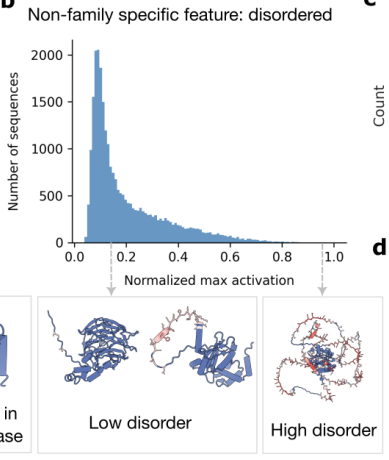 Ref (2)
See also
- Sparse autoencoders recover protein-family and gene-ontology features from PLM representations
- Sparse autoencoder-derived features do not outperform PLM-derived embeddings for downstream prediction
- Thermostability prediction from protein language model representations peaks in the last few layers
- Protein property prediction using PLMs does not benefit from scale except when predicting inferring features of either structural or sparsely populated sequence families
1.
Whitfield ST, Marty T, Vernon RM, Langmead CJ, Sridhar D, Fournier Q. High-resolution dissection of concept acquisition in different families of protein language models. 2026. Available from: https://doi.org/10.64898/2026.07.20.739599
2.
Adams E, Bai L, Lee M, Yu Y, AlQuraishi M. From Mechanistic Interpretability to Mechanistic Biology: Training, Evaluating, and Interpreting Sparse Autoencoders on Protein Language Models. openRxiv; 2025. Available from: https://doi.org/10.1101/2025.02.06.636901