Summary
Including pLDDT and pTM values from structure prediction as losses during inverse folding improves sequence diversity but not sequence recovery (1). By contrast, Corso et al. (2) found that including confidence in small molecule docking using DiffDock improved docking recovery. (3) found that predicting confidence of each residue and using that as information can improve sequence recovery (“teacher models”), leading their model to outperform other methods such as ProteinMPNN.
Details
(1) used a distilled version of AlphaFold2 to calculate pLDDT and pTM.
Figures
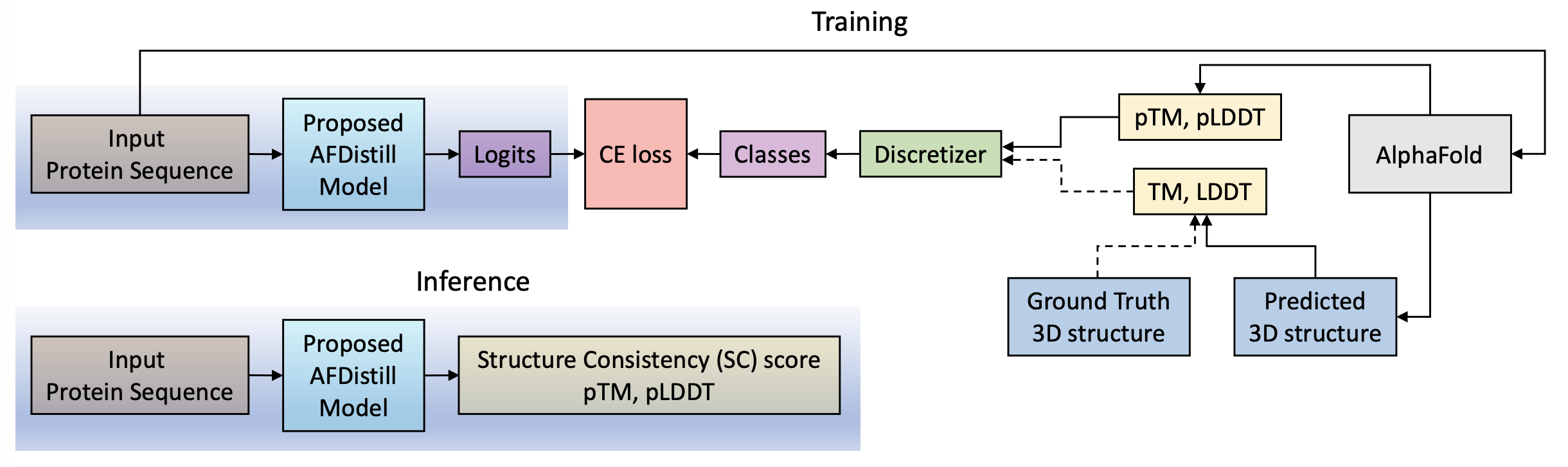 Ref (1)
1.
Melnyk I, Lozano A, Das P, Chenthamarakshan V. AlphaFold Distillation for Protein Design. 2022; Available from: https://arxiv.org/abs/2210.03488
2.
Corso G, Deng A, Fry B, Polizzi N, Barzilay R, Jaakkola T. Deep Confident Steps to New Pockets: Strategies for Docking Generalization. 2024; Available from: https://arxiv.org/abs/2402.18396
3.
Gao Z, Tan C, Li SZ. Knowledge-Design: Pushing the Limit of Protein Design via Knowledge Refinement. 2023; Available from: https://arxiv.org/abs/2305.15151