Summary
Using inverse folding to select positions for site-saturation mutagenesis can produce higher experimental hit rates than random mutagenesis (1). ESM-IF-guided library design followed by selection identified multiple Rubisco variants with improved catalytic efficiency. This is complementary to the observation that directed evolution can discover beneficial mutations missed by inverse folding: inverse folding can improve which positions are explored, while experimental selection can still recover mutations outside the model’s preferred sequence space.
Figures
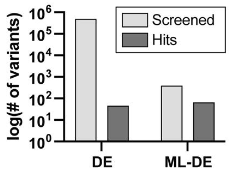 Machine-learning-guided directed evolution yields a higher fraction of hits than conventional directed evolution. Ref (1)
See also
- Directed evolution
- Inverse folding selects more evolutionarily conserved design positions than sequence-only protein language models
- ML improves directed evolution when navigating fitness landscapes with greater non-magnitude epistasis
1.
McDonald JL, Lin J, Zhao Y, Hie BL, Birch R, Gehring M, et al. Machine learning-assisted directed evolution of plant Rubisco. 2026. Available from: https://doi.org/10.64898/2026.07.25.740226