Kinked CDRH3 are a conformational feature found in 80-90% of human antibodies and nearly 60% of camelid nanobodies (1,2). This occurs at the C-terminus of the loop and is dictated by germline use. Similar bends are found in other proteins, such as PDZ domains and peptidase C1 domains, that are involved in protein-protein interactions (1).
 Ref
Ref 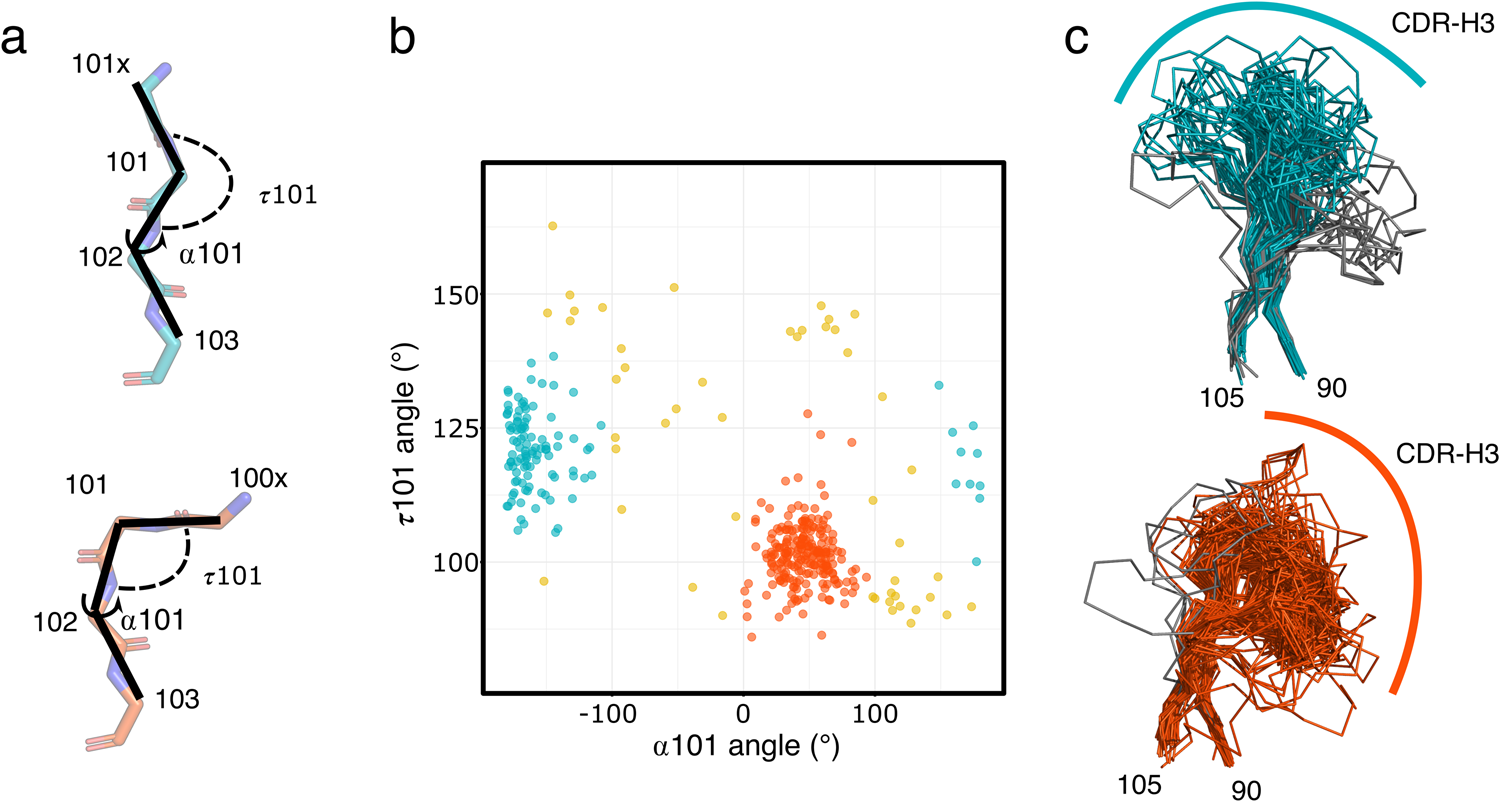 Ref
Ref Details
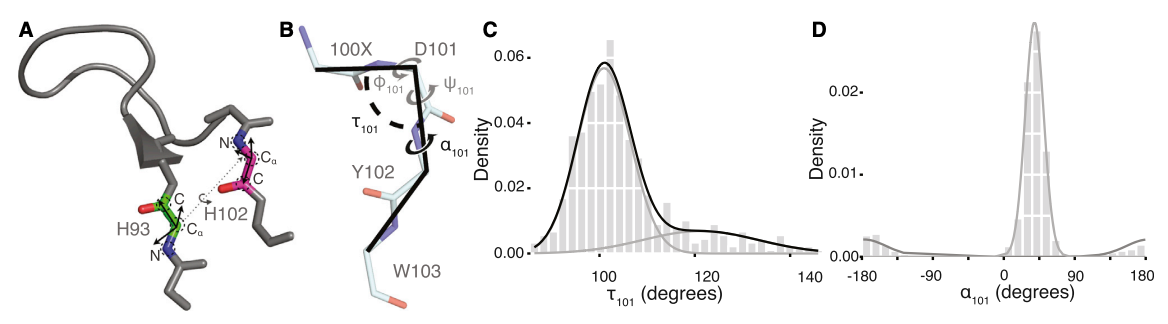
The precise definition by Weitzner et al uses the following two parameters:
- : -- pseudo-bond angle over the three C-terminal loop residues (Chothia 100X–101–102, IMGT 115-116-117).
- : --- pseudo-dihedral angle over the same three residues plus the next one (Chothia 103, IMGT 118).
Then, a two-parameter model is fit over these that includes a Gaussian component centered at (80% of structures) and a von Mises component centered at . This includes about 80% of structures in the PDB at the time of the Weitzner paper. Loops that fall into this component are considered kinked, while those that don’t are considered extended or straight.