Summary
Protein language models can be converted into inverse folding models by adding intermediate adapter layers and fine-tuning on structural data ((1), using ProGen models; (2) using ESM2-650M). This leads to improvements in sequence recovery and fitness prediction beyond what can be achieved by concatenation. Larger models maintain the improvements in perplexity. These structures can include non-protein material if the adaptor layer allows it. This is conceptually similar to LoRA. (1) validate designs in the wet lab.
Figures
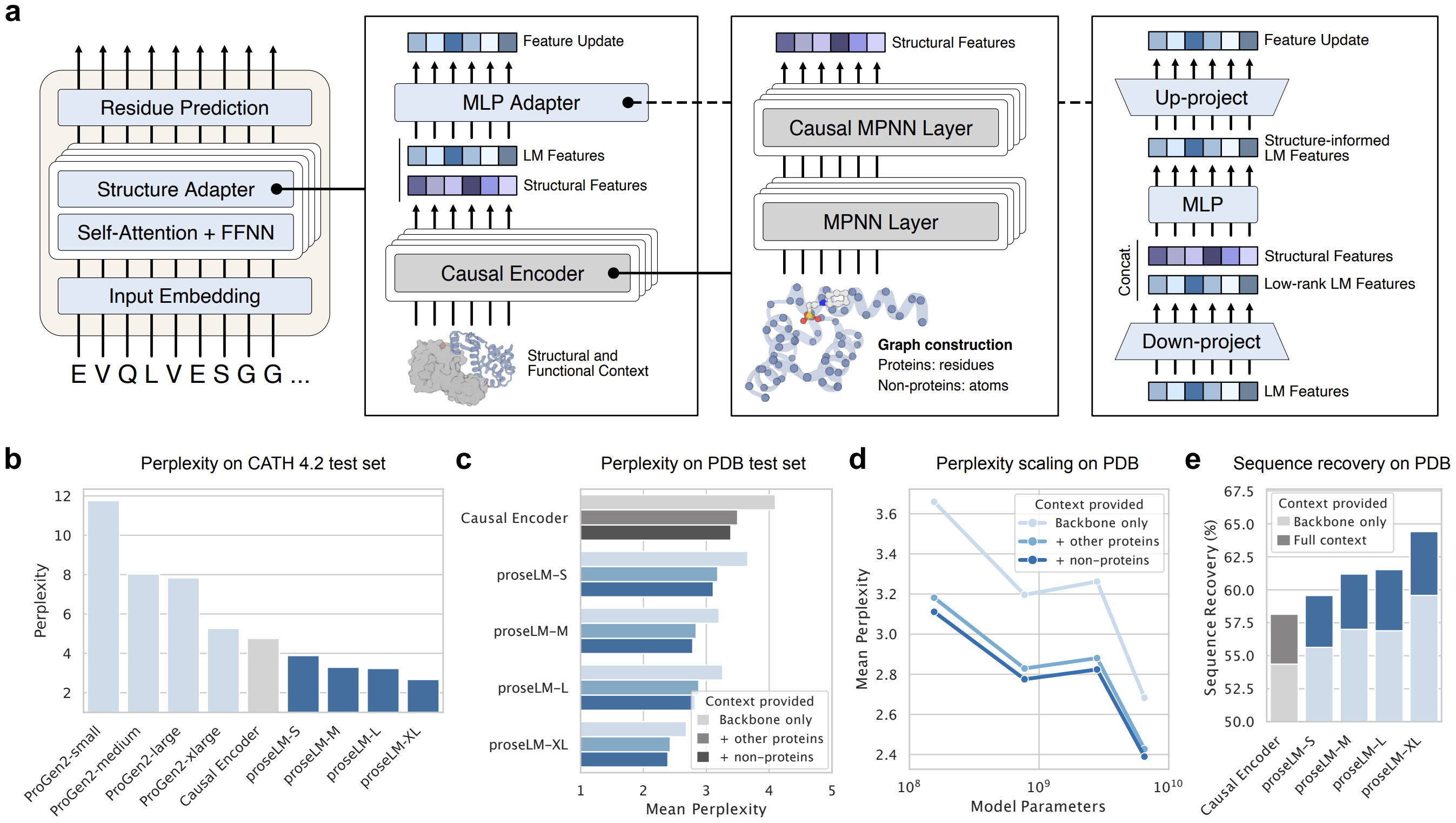
Ref (1)
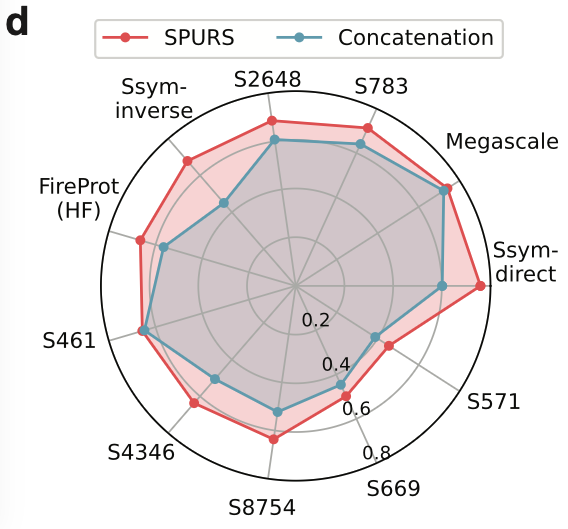
Ref (2)
See also
1.
Ruffolo JA, Bhatnagar A, Beazer J, Nayfach S, Russ J, Hill E, et al. Adapting protein language models for structure-conditioned design. openRxiv; 2024. Available from: https://doi.org/10.1101/2024.08.03.606485
2.
Li Z, Luo Y. Generalizable and scalable protein stability prediction with rewired protein generative models. Nature Communications. 2025;17(1). Available from: https://doi.org/10.1038/s41467-025-67609-4